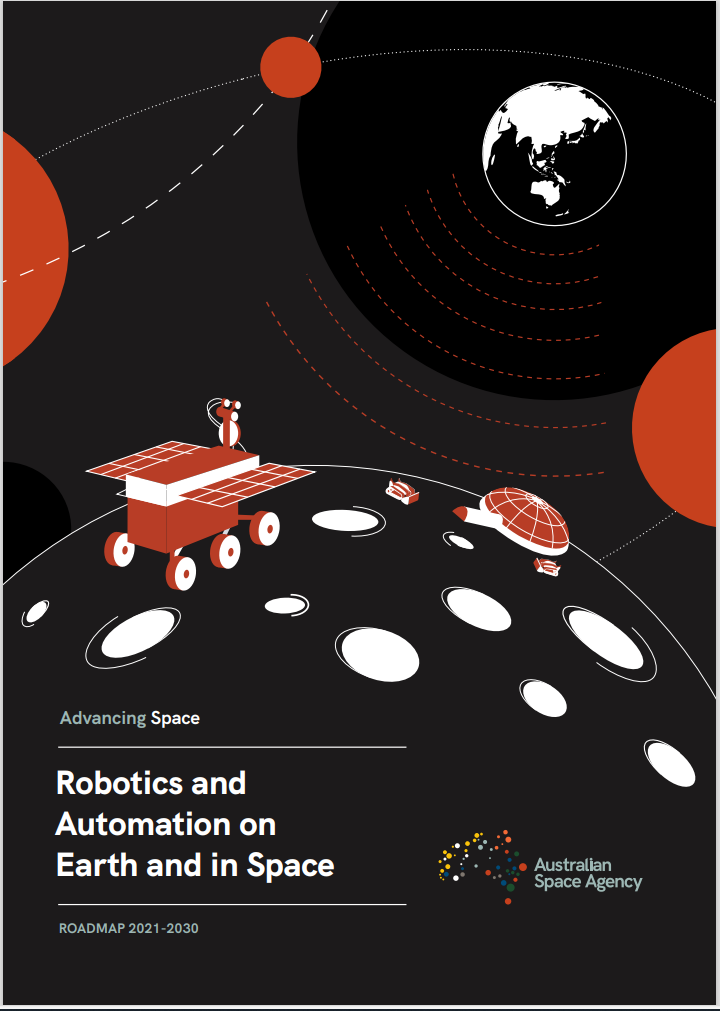
The Australian Space Agency’s Robotics and Automation on Earth and in Space Roadmap outlined a 10-year plan to support growth of robotics and automation capabilities on Earth and in space. This plan was published before May 2022 under the previous Australian Government.

Overview

Australia’s remote operation capabilities have huge potential for the future of space exploration. The Robotics Roadmap described a pathway to:

  • leverage Australia’s expertise in robotics technology and systems
  • provide critical solutions into the global marketplace that enable and support the sustained build-up of space assets and infrastructure
  • enable international collaboration with industry. 

Publication content 

The following 6 focus segments prioritised in the Robotics Roadmap, were considered the areas of greatest opportunity for the Australian space sector:

  1. Remote operations
  2. Interoperability
  3. Analogue facilities and services
  4. Robotic platforms
  5. In-Situ Resource utilisation
  6. Foundation services.

Foundation Services 

Foundation Services are operational services that support exploration missions to build towards (and eventually maintain) a sustained off-Earth presence. They are services for which demand is recurrent, continuous or enduring. The scope of Foundation Services covers monitoring and inspection, planning and logistics, civil construction, materials transport and cargo handling, remote maintenance, salvage, and component manufacture and assembly. They are distinctive but complementary to mission critical systems such as power, communications and life support.

Foundation Services fulfil a set of core supportive processes and systems that are necessary in planning, establishing and sustaining planetary activity. These services provide core functions that are required during every stage of off-Earth infrastructure build-up. Australia can use its capabilities to realise a long-term flagship role in Foundation Services.
Latest from the Australian space sector

TEMPOSpace PFM testing_PhotoCredit_QuantX Labs

Perfect timing: Aussie quantum clock innovation becomes a world-first capability

NEWS • National capability

31 March 2026

QuantX Labs launched an optical frequency comb to space — advancing its TEMPO.Space optical atomic clock. This technology is backed by an Australian Space Agency’s program.

Read more
A rendering of the Intuitive Machines larger cargo class (Nova-D) lunar lander with the Australian Space Agency’s Roo-ver lunar rover (lower left).

Aussie Moon rover's journey confirmed

NEWS • Partnerships

28 March 2026

NASA selects Intuitive Machines to carry Australia’s Roo‑ver to the lunar South Pole region in 2030.

Read more
Students must design, test and build a prototype

Young Aussie kids invited to take on Mission: SPACE challenge

NEWS • Inspiring Australia

20 March 2026

Expressions of interest are now open for this national program will be delivered by Scitech and is powered by the Australian Space Agency to shape the imaginations and capabilities of the next generation.

Read more
Chris Shaw, CEO and co-founder of Advanced Navigation with miniaturized inertial system

$50 million NRFC investment for Aussie Earth and space navigation technology

NEWS • National capability

18 March 2026

Funding from the National Reconstruction Fund Corporation boosts Advanced Navigation's valuation to more than $1 billion.

Read more
SLS and Orion lifted off from Launch Complex 39B at Kennedy at 1:47 a.m. EST on Nov. 16, illuminating the night sky. An initial assessment showed the rocket performed with precision, meeting or exceeding all expectations during its debut launch. NASA/Joel Kowsky.

A Century of Lift‑offs

NEWS • Space history and culture

16 March 2026

Robert Goddard, assisted by his wife Esther, sent the first liquid-fuelled rocket aloft on 16 March 1926. Explore with our interactive image gallery how far the technology has come, since he lit the fuse on a tiny rocket 100 years ago!

Read more
space technology

Roo-ver Research: The University of Melbourne

NEWS • Industry showcase: Space spotlight

10 March 2026

With temperatures ranging between hundreds of degrees on the Moon, the University of Melbourne is managing the temperature of Australia’s first lunar rover.

Read more

Our department recognises the First Peoples of this Nation and their ongoing cultural and spiritual connections to the lands, waters, seas, skies, and communities.

We Acknowledge First Nations Peoples as the Traditional Custodians and Lore Keepers of the oldest living culture and pay respects to their Elders past and present. We extend that respect to all First Nations Peoples.