
Advanced Navigation’s new sensor enables laser-guided precision landings on the Moon, and it’s set to push navigation technology forward on Earth as well.
As we enter the era of the NASA-led Artemis program to return the Moon – and establish a sustainable human presence to live and work there – mission partners need to reliably land vehicles on a regular basis. Unlike last century’s Apollo Lunar Module, however, the vast majority of today’s vehicles won’t be guided down manually by astronauts; they’ll be uncrewed vehicles touching down autonomously. Since GPS doesn’t work and visibility is often poor, Sydney-based Advanced Navigation is using laser technology to solve the problem.
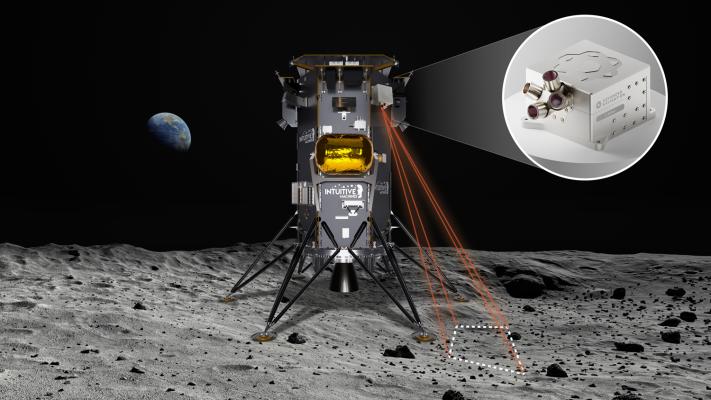
LUNA (Laser measurement Unit for Navigation Aid) is a compact system that attaches to a lunar vehicle and points laser beams at the landing site to measure the vehicle’s velocity and altitude on approach. The constant 3D data provided by the laser beams enable the vehicle to anticipate the rocky, uneven patch of the Moon it’s headed for, correct its course in real-time, and execute a controlled landing.
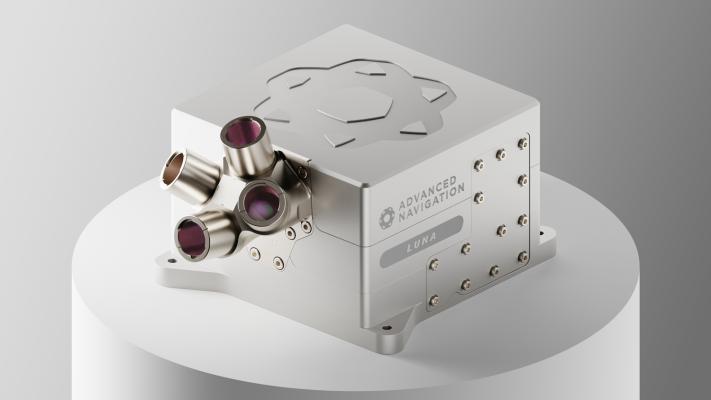
LUNA unit on display
The LUNA validation program included a light aircraft flight over the sandy Pinnacles Desert in Western Australia, yielding only 28m of error after 100km of flight. A test was also conducted 400m below ground in Europe’s deepest mine in Pyhäjärvi, Finland, to simulate LUNA’s potential as a navigation tool for rovers across the lunar surface – producing an average error of just 0.047%.
LUNA’s first use in space will be to guide an Intuitive Machines NOVA-C lander onto the lunar surface in the IM-4 mission, which will deliver and deploy a range of NASA payloads to the Moon. The IM-4 mission is being delivered by Intuitive Machines as a contractor with NASA’s Commercial Lunar Payload Services (CLPS) program. Meanwhile, Advanced Navigation is using its validation successes to develop a terrestrial version of LUNA – which will give industries such as mining and defence an even more accurate alternative to GPS in navigating the most extreme terrain on Earth.
“For decades, landing on the Moon has meant flying with only partial vision in the final kilometres… turning every descent into a high-stakes calculation. Our LUNA sensor aims to give lunar landers and rovers hyper-accurate ‘laser vision’ to see their own speed and position in the darkness of space."
~ Chris Shaw, CEO and Co-Founder of Advanced Navigation.
Technology features
- Laser‑based navigation delivering real‑time, drift‑free 3D velocity, altitude, and range measurements.
- Capability far more sensitive than radar using Laser Doppler Velocimetry and LiDAR (Light Detection and Ranging) techniques.
- Ultra‑compact, high‑performance sensor weighing less than 3kg, and around eight times smaller than comparable systems – saving millions of dollars in mission costs over legacy systems.
- Reliable operation in GPS‑denied and low‑visibility environments – enabling precision landing and mobility even in darkness, dust, and complex terrain.
Pictured above: Artist’s impression of LUNA operating on an Intuitive Machines lander on the Moon. Credit: Advanced Navigation/Intuitive Machines.
Project highlights
- Agency Moon to Mars grant awarded to develop the mission-ready payload.
- Earth‑based validation meeting mission performance requirements with sub‑percent position error.
- Integration with a future Intuitive Machines mission to demonstrate controlled descent and landing on the Moon.
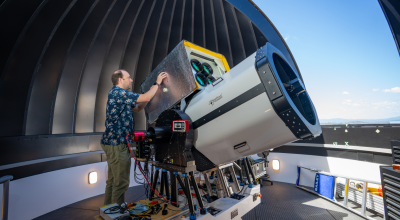
- Strengthening Australian space industry capability through partnerships with NH Micro and Australian Astronomical Optics and engineering model progress.
- Technology transfer leading to commercialisation of a world‑first terrestrial system.
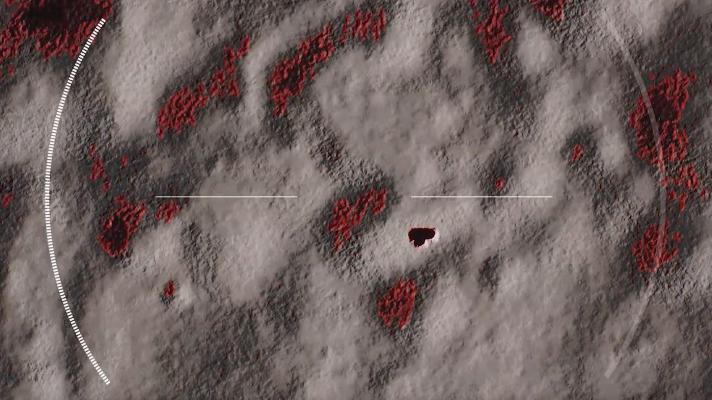
Pictured above: Artist’s impression of what LUNA can ‘see’ on the lunar surface. Credit: Advanced Navigation
Industry Showcase
Australian space innovations making an impact.