
Growing roots inside the International Space Station (ISS).
A plant‑growth experiment led by the University of Southern Queensland (UniSQ) was launched into orbit from Cape Canaveral Space Force Station in Florida, US.
The Aussie experiment could prove to be a standout example of Australia’s growing capabilities in space‑based agriculture and sensing — turning home‑grown research into orbital reality.
The launched project was onboard NASA’s SpaceX Crew-12 mission, where four astronauts will conduct research, technology demonstrations, and maintenance aboard the orbiting laboratory.
European Space Agency (ESA) astronaut and Mission Specialist Sophie Adenot is one of the crew members headed to the ISS. She graduated with Australian astronaut Katherine Bennell-Pegg from their ESA astronaut training in 2023.
Examining how plants respond in space and on Earth
As Australia and the rest of the world prepare for longer‑duration missions, understanding reliable plant growth in space will be essential for food, materials and medical manufacturing across deep‑space journeys.
UniSQ's project will study plant growth in microgravity using advanced imaging and artificial intelligence.
“In this project, we are sending two small greenhouses to the ISS which contain plants, and we are going to use cameras to monitor their growth,”
~ Project Lead and Associate Professor Cheryl McCarthy from UniSQ.
Inside the ISS, camera systems will continuously capture daily imagery to detect early signs of plant stress — well before they are visible to the human eye — across two chambers designed for healthy and intentionally stressed growth conditions.
Each payload houses a miniaturised, closed‑terrarium greenhouse (200 mm × 100 mm × 100 mm) containing agar and essential nutrients, with lettuce selected as the test species to reveal early indicators of plant health in orbit.
The breakthrough goal is to demonstrate machine‑vision algorithms that can spot stress early using low‑cost, space‑tolerant cameras — technology with immediate relevance for controlled‑environment agriculture on Earth.
The launched experiment showcases national strengths in space research and advanced manufacturing as well as complex space payloads with real‑world benefits back on Earth.
Beyond space exploration, the technology points to powerful terrestrial applications: combining machine vision, sensors and artificial intelligence could allow remote farms and controlled facilities to monitor and manage plant health with minimal human oversight.
The project was funded by the iLAuNCH Trailblazer, which is part of the Australian Government’s Trailblazer Universities Program. An early concept for the experiment was supported by the Australian Space Agency’s Moon to Mars Initiative Demonstrator Feasibility program, and the technology was developed further through an International Bilateral Fund project co-funded by the Australian and UK Space Agencies.
It was also delivered with international and industry partners including:
- Axiom Space provided spaceflight and payload expertise
- Yuri Gravity supported experiment design, electronics manufacturing, and launch logistics
- Australian agribusiness Medicinal Harvest supported with ground‑based trials.
Industry showcase
Australian space innovations making an impact
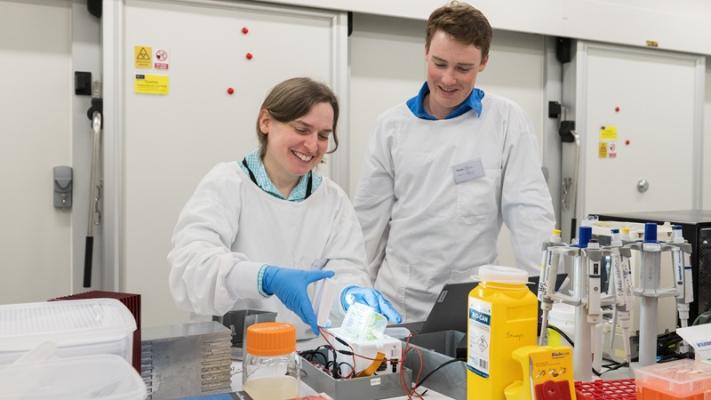
Main image caption: UniSQ Associate Professor Cheryl McCarthy and Research Assistant Isaac Halling conducting lab testing.
Credit: iLAuNCH