
Career story
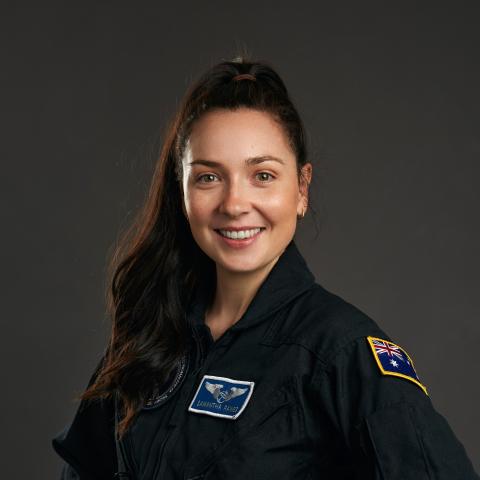
Samantha Raines is a robotics expert helping shape Australia’s space future. Drawing on her deep-sea and aviation experience, she develops autonomous systems for lunar exploration, including her work on the Roo-ver mission and space sustainability initiatives.
“For me, space represents the ultimate frontier of discovery, where science, technology, and imagination intersect,” says Samantha.
From a young age, Samantha was captivated by astronauts and deep-sea explorers. As she built her career in robotics, she saw clear parallels between the technologies used to explore the ocean floor and those needed for missions to the Moon or Mars.
Her passion for robotics and real-time decision-making systems began in the aviation and mining sectors, where she worked on predictive systems, intelligent autonomy, and remote control for critical operations. She later transitioned into subsea robotics, contributing to high-fidelity simulations and autonomous systems designed for underwater environments.
“Navigating dynamic, remote, and unstructured terrains underwater gave me a natural bridge into the space industry.”
Engineering Australia’s Space Future
Samantha holds a Master’s in Computer Science and contributed to the student-built satellite Acrux-1 during her time at RMIT. Since then, she has focused on building technologies that thrive in extreme environments, participating in analogue missions, robotics field testing, and space hardware design.
Her studies at the International Space University (ISU) deepened her understanding of the intersections between space, policy, and exploration. While at ISU, she co-authored a paper on how space-based technologies can support bushfire prevention.
A major milestone in her career was being selected to contribute to Australia’s first lunar rover, Roo-ver. Samantha works on the autonomy software and led the development of the camera system that will capture images of the lunar surface.
She recently completed a parabolic microgravity flight to test hardware under lunar-gravity conditions — an experiment combining lunar regolith simulants, stereo vision systems, and robotics in a challenging, high-impact environment.
“Australia’s space industry is still young, but it has extraordinary potential to grow and lead in key areas. We’re uniquely positioned to make a real impact in Earth observation, climate science, remote operations, and robotics.”
“Our experience working in remote and extreme environments—from deserts to oceans—gives us a strong foundation for developing technologies that support both space exploration and sustainability here on Earth. Australia’s role in space is about more than rockets and rovers; it’s about responsibility, resilience, and reimagining what’s possible for humanity,” she adds.
Career journey
Worked as a Software Developer at General Electric (Aviation, subsea systems, remote operations)
Won best hardware in NASA challenge to prototype a jetpack-style rocket for Mars exploration.
Worked for Contino as a Lead Data Engineer (Aviation).
- Completed a Masters of Computer Science, RMIT.
- Contributed on student satellite Acrux-1.
Worked for IBM Asia Pacific as the AI Developer Lead (Aviation, Mining, Remote Operations).
Commenced studies at International Space University.
Senior Robotics Engineer at Fugro (Marine, Space).
Worked on the Roo-ver Mission for EPE as a Senior Software Engineer.