
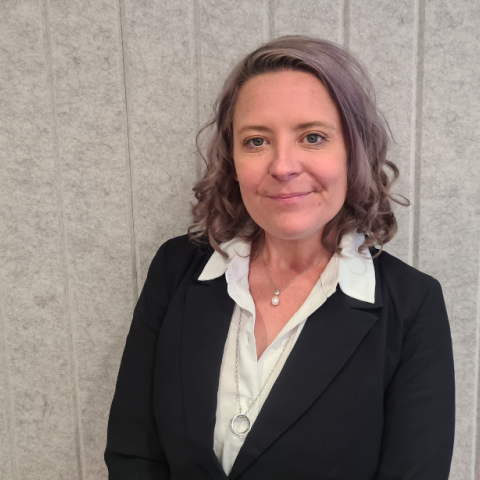
Career story
Helping shape a peaceful future.
For Bec O'Brien, a career in space began not at a launch site or inside a mission control centre, but in a university lecture theatre.
While completing her Juris Doctor at The Australian National University, Bec enrolled in an elective on space law taught by Professor Steven Freeland and it took only two lectures for her to recognise an extraordinary opportunity.
“If I could do any sort of law,” she remembers thinking, “why wouldn’t it be space law?”
What captured Bec’s imagination was not simply the excitement of rockets, satellites, and lunar exploration. It was the discovery that laws made on Earth can influence humanity’s future in space.
Space law establishes the framework for the peaceful and cooperative use of outer space. The decisions governments and international organisations make today will shape how people explore, conduct research and establish a long-term presence in space for decades to come.
As Bec puts it, these rules may help determine whether our future looks “more Star Trek than Star Wars” – one built on cooperation rather than conflict.
Today, Bec works on reforming Australia’s civil space regulatory framework at the Australian Space Agency. In everyday terms, she helps develop the rules that allow Australian space activities to grow while protecting the people conducting them, the Australian public and the international community.
This balance is essential. Clear and practical regulation gives Australian businesses, researchers and investors the confidence to pursue ambitious space projects.
At the same time, it ensures that launches, satellite operations and emerging technologies are undertaken safely and responsibly.
Although space can feel distant, Australians rely on it every day. Satellites support navigation, communications, weather forecasting, emergency responses, agriculture, and environmental monitoring. Protecting the space environment therefore also protects important services used by communities across Australia.
Bec’s work reaches beyond Australia. She supports the country’s engagement with international forums, including the United Nations Committee on the Peaceful Uses of Outer Space. There, nations work together to develop shared rules and norms for safe, peaceful and sustainable activities.
This task is becoming increasingly urgent. More countries and private companies are entering space, while technologies such as satellite servicing and in-orbit manoeuvring are becoming more sophisticated. It is important for the international community to establish “road rules” for satellites, reduce space debris and manage defunct objects that remain in orbit. Without cooperation, crowded orbital pathways could endanger satellites and limit opportunities for future generations.
Australia is well placed to contribute. As a founding signatory of the Artemis Accords, Australia is part of an international conversation about responsible space exploration and how long-established treaty principles can be applied to new missions.
Bec is excited that Australia is evolving from primarily a consumer of space-based services into an active and diverse space participant. Australians are designing and building a rover to explore the Moon. Universities are investigating how plant science could support long-term human habitation beyond Earth. Australia also continues to play an important role in deep-space communications and international space governance.
For students, this expanding sector offers pathways across government, law, science, engineering, research, defence, academia, insurance, intellectual property and commercial space companies.
Bec’s advice is to cultivate curiosity, flexibility and critical thinking. Space activities constantly test how existing laws apply to unfamiliar situations, so strong communication, analysis, ethics and international cooperation are invaluable.
Most importantly, students should remain open to unexpected opportunities. Bec found her direction through one university elective. The next generation may begin just as simply – with a lecture, a question or the realisation that space is not only for astronauts. It also needs thoughtful people on Earth to help keep it peaceful, safe, and open to everyone.
Career timeline
Graduated with a with a Bachelor of Arts (Honours) (First Class, Sociology) from the University of Sydney.
Board Member and Vice-Chair of Sydney Women’s Counselling Centre, a community-based specialist counselling service for women who have experienced domestic violence.
Bec worked for several Go8 universities providing advice and support in relation to tertiary policy, administration, compliance and governance.
Graduated with a Juris Doctor (with Commendation) from the Australian National University. Bec completed the Graduate Research Unit on with a research project on the role of international and domestic space law in the management of the use of celestial bodies.
Bec joined the Australian Space Agency as a Senior Regulatory Officer supporting the design and delivery of reform to the Space (Launches and Returns) Act 2018 and associated legislative framework, as well as the design of a medium-long term regulatory modernisation plan.
Completed the Australia and New Zealand School of Government and National Regulators Community of Practice: The Professional Regulator.
- Bec became the (Acting) Assistance Director, Regulatory Review, working to reform to the Space (Launches and Returns) Act 2018 and associated legislative framework and developing and leading delivery of a regulatory roadmap.
- Bec also supports the Space Governance and Regulation team’s engagement in multilateral fora such as UNCOPUOS and Australia’s contribution to the development of international space governance through its subcommittees and working groups.