
Zendir is championing artificial intelligence as a powerful tool for minimising orbital congestion and keeping the space domain safe.
With tens of thousands of active satellites and space debris objects currently orbiting the Earth – and new launches steadily adding to that number – the global space sector is increasingly looking for ways to operate more sustainably. Canberra-based company Zendir is responding to this challenge with expertise in AI and digital twin technology.
From the ground, the large data processing capacity of AI can help more accurately predict orbital collision risks, and more clearly identify different objects in orbit. When applied aboard orbiting satellites, it can autonomously plan and execute rapid satellite manoeuvres to avoid collisions, and extend the satellite’s usable life by managing resources like fuel and battery power more efficiently. Meanwhile, machine learning can be used to recalibrate the systems while they operate and collect more data – continuously improving their accuracy and reliability.

Caption: ESA rendering of objects in Low Earth Orbit
Credit: ESA
In 2023, with support from the Australian Space Agency, Zendir joined AI4S3: an international consortium to develop AI-driven frameworks and tools that improve the safety and sustainability of space operations. The pioneering consortium led by the University of Strathclyde was funded by the UK Space Agency, and also featured the Massachusetts Institute of Technology, the University of Arizona, the University of Waterloo, Columbiad, GMV, LMO, and the Alan Turing Institute.
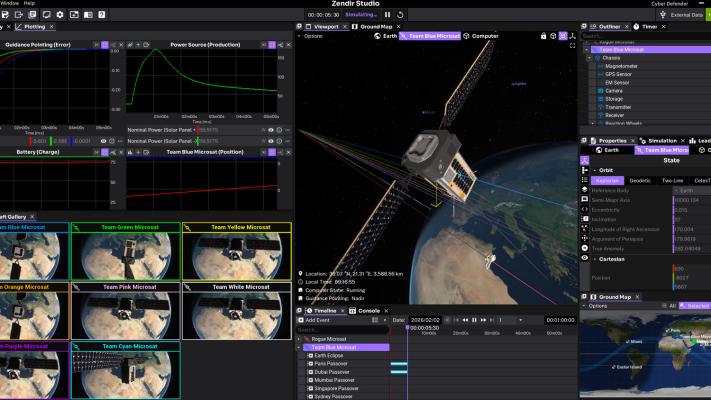
As part of the consortium, Zendir developed adaptive machine learning models for collision avoidance that can process data from multiple tracking networks and satellites in close to real time. It created ‘explainable AI’ (XAI) systems that provide operators with clear rationales for recommendations, enabling them to understand and trust the automated decisions. It also developed digital twin technology to provide high-fidelity simulations of orbital environments that validate AI-based decisions. In addition, it provided AI-powered assessments of orbital traffic trends and environmental risks, to inform the future development of operational sustainability standards.
The future of space will be automated, but first we must prove it's safe. Through AI4S3, Zendir is helping provide the digital test ground needed to validate AI-enabled space operations so they can be trusted in orbit. This is about building confidence in the systems that will keep space safe, sustainable and resilient, and showing how Australia can help the world trust the next generation of space automation.
~ Dr Christopher Capon, co-founder and CEO of Zendir
Technology features
- Machine learning to predict space object motion.
- AI-enabled forecasts of satellite and debris trajectories, reducing collision risks and improving operational safety.
- Classification and behavioural analysis of space objects, with AI algorithm analysis identifying what objects are and what they are doing – improving situational awareness in orbit.
- AI-driven mission decision support and assessment of mission impacts on the space environment – supporting better policy, licensing, risk analysis, and insurance choices.
Pictured above: An example of Zendir’s software user interface. Credit: Zendir

Project highlights
- $2.84 million international collaboration backed by the UK Space Agency’s International Bilateral Fund (IBF), with support from the Australian Space Agency.
- Universities, institutes, and commercial partners brought together through the IBF initiative.
- Consortium partnership with leading industry players to co-develop advanced AI capabilities.
- Consortium hosted two successful AI for Space Sustainability workshops in 2024.
- Collaborated with the University to integrate AI-powered synthetic tracking data generation, improving conjunction analysis.
Pictured above: Zendir team members at Osaka World Expo 2025. Credit: Zendir
Industry showcase
Australian space innovations making an impact.