
Career story
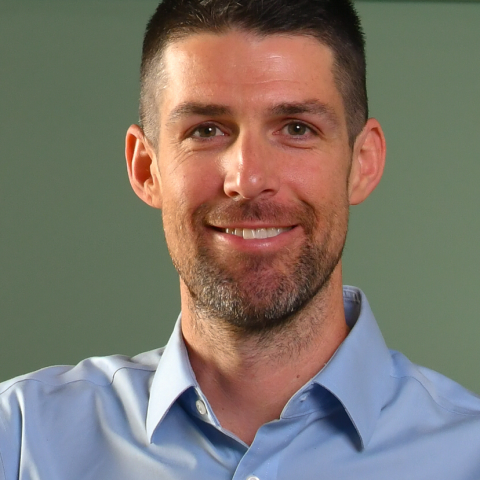
The path into space sometimes begins with a telescope, a childhood dream or a rocket launch watched on television. For this senior Australian space sector professional, it began in a family living room, listening to stories about an egg.
While completing his Victorian Certificate of Education, Shannon Ryan would hear his older sister’s boyfriend, then studying Aerospace Engineering, talk about university projects.
One stood out: launching an egg payload on a model rocket and designing a parachute system to bring it safely back to Earth. It was practical, imaginative, and just a little audacious – exactly the kind of challenge that makes engineering feel alive.
With no fixed career plan but a growing sense of curiosity, Shannon applied to study Aerospace Engineering at RMIT. During the degree, space-related subjects quickly became the most compelling. The idea that engineering could reach beyond Earth’s atmosphere, while still solving very real problems, proved irresistible.
An unexpected launchpad
That curiosity eventually led to an international turning point. Like many students in the program, Shannon was encouraged to complete an industry placement overseas, supported by the school’s strong links with Germany. An initial six-week internship at the German Aerospace Center fell through, but the alternative changed the course of his career.
Fraunhofer EMI, a Germany-based research institute, offered not six weeks, but twelve months in its spacecraft safety technology group. What began as a replacement placement became an industry-based master’s degree and then a PhD.
In Germany, Shannon entered a specialised and increasingly important field: protecting spacecraft from hypervelocity impacts.
In orbit, even a fragment of debris only a few millimetres wide can strike a satellite at extraordinary speed, releasing enough energy to damage critical systems. These tiny objects are difficult to track, but they represent one of the greatest risks to spacecraft in low Earth orbit.
Bringing AI to Space Safety
Today, Shannon's research focuses on using physics-informed artificial intelligence to better model and predict these impacts. It is a field that combines deep engineering knowledge with emerging digital tools.
Spacecraft operators already complete debris risk assessments as part of mission planning and licensing, but many of the equations and technologies used in those assessments are more than two decades old. Because these decisions affect safety, the process is understandably conservative.
His work aims to make risk assessment more accurate, more capable and better suited to an increasingly crowded orbital environment.
This isn't change that happens overnight. Introducing AI into safety-critical space systems requires trust, evidence, and patience. But the long-term goal is clear: to help satellite operators understand their risks more precisely and design missions that are both ambitious and responsible.
Why space debris matters to Australians
For Australians, this work matters more than many realise. Space debris is not a distant problem reserved for astronauts and satellite companies.
Modern life depends on satellites for weather forecasting, bushfire monitoring, emergency communications, navigation, banking, agriculture, environmental management, and national security.
If the orbital environment becomes too hazardous, the services Australians rely on every day become more vulnerable. Protecting space infrastructure is therefore also about protecting communities on Earth. In a country shaped by vast distances, remote communities and climate extremes, reliable space-based services are not luxuries – they are part of national resilience.
A shared resource, a shared responsibility
Space sustainability has become a global imperative because orbit is a shared resource. The European Space Agency’s Zero Debris Charter, the Inter-Agency Space Debris Coordination Committee and United Nations guidelines all play important roles, though enforcement depends on national and regional governments.
Australia’s associate membership of the IADC is therefore a significant milestone. It gives Australia a voice in the leading technical forum shaping global debris mitigation practice, and ensures national interests are represented as rules and expectations evolve.
Stay flexible and be adaptable
For students and early-career professionals, Shannon's advice is grounded in experience: stay flexible and adaptable. Space careers are rarely linear. Opportunities can be scattered across countries, institutions, and disciplines. Demand can rise quickly and fall just as fast.
The people who thrive are adaptable, curious and willing to follow unexpected openings – even when they begin with something as simple as an egg on a rocket.
Career journey
Completed Bachelor of Aerospace Engineering at RMIT University.
Joined the Fraunhofer Ernst-Mach-Institute (EMI) in Freiburg, Germany, initially as a Masters student but then as a PhD student working within the Spacecraft Safety Technology Group. My PhD project contributed to European Space Agency contracts at EMI that were investigating the effect of space debris impact on the Columbus module and ESA’s upcoming Earth Explorer series of satellites.
Moved to the Lunar and Planetary Institute (LPI) in Houston for my postdoctoral fellowship at the NASA Johnson Space Center. I was a member of the Hypervelocity Impact Technology Group, where my work focused on the development of new physical shielding for protecting manned spacecraft against space debris impact. Part of my job included postflight inspections of Space Shuttle Orbiters and returned International Space Station modules for space debris impact damage.
Returned to Australia and joined the Defence Science and Technology Group (DSTG). Here my research focused on protective systems for land vehicles. I first begun to work with machine learning as part of a Chief Defence Scientist fellowship at DSTG.
Moved to Deakin University, initially as the Head of Defence and Space Research within the Applied Artificial Intelligence Institute (A2I2) and then later as an Associate Professor of Mechanical Engineering. One of my research interests is space debris impact and spacecraft physical resilience.