
Based at Mount Stromlo, the ANU Quantum Optical Ground Station uses laser beams to communicate with missions in low Earth orbit, lunar orbit, and deep space beyond.
The infrared light travelling to and from the station’s telescope can transmit data up to 100 times faster than traditional radio technology – making it ideal for sending high-definition video, picture, voice, and scientific data. It’s a reliable, secure communications platform for the satellite networks Australia depends on, and for space missions worldwide. As well as helping to establish Australia as a leading service provider in a lucrative global market, the capability also creates exciting new opportunities for Australian researchers to pioneer advanced communications techniques.
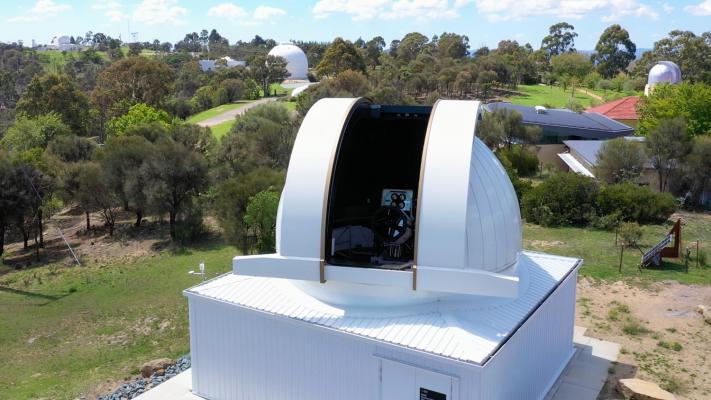
The ANU Quantum Optical Ground Station. Credit: ANU
In 2023, the Australian Space Agency awarded ANU a $4.5 million Moon to Mars grant to enhance the telescope in partnership with NASA. The upgrades equipped the station to communicate with NASA’s historic crewed Artemis lunar missions – and in 2026, the station tracked, transmitted, and received communications from the Orion capsule flying NASA’s Artemis II astronauts around the Moon. It was a world-first, marking the furthest distance a crewed mission has ever transmitted data via a laser system. The demonstration also proved the station’s viability as a Southern Hemisphere base for communications to support permanent NASA operations on the Moon, and journeying onwards to Mars.
Meanwhile, in addition to the NASA connection, the upgraded capability funded by the Agency paves the way for a future commercial optical communication service that utilises Australia’s world-leading expertise.
Building this capability in the Southern Hemisphere is critical to establishing reliable communication to the moon and the Solar System… ANU and Australia are ready to support future space exploration and commercial missions.
~ Dr Kate Ferguson, Associate Director Strategic Projects at the ANU Institute for Space
Technology features
- Faster, smarter mission connectivity via next-generation laser communications – a method which transmits data significantly faster than traditional radio systems.
- Ability to deliver high-definition video, imagery, and data across vast distances in space, including to and from the Moon.
- Direct communication link between Australia and missions operating around the Moon and beyond.
- A foundation for secure, high-capacity quantum communications networks that will support future space missions.
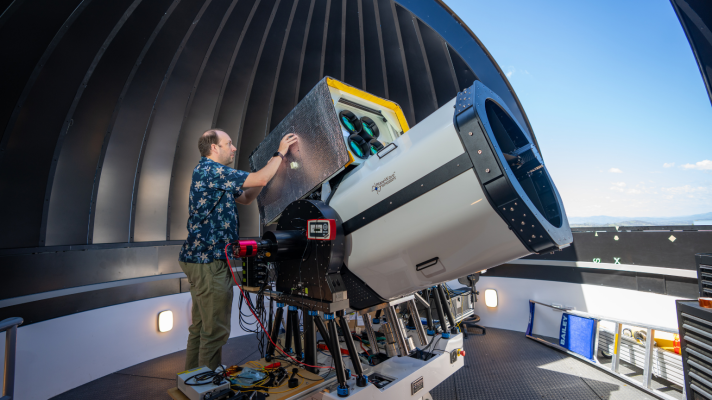
Pictured above: Inside the observatory. Credit: ANU
Project highlights
- Agency Moon to Mars grant awarded to install technology that enables communication with future crewed NASA lunar missions, as well as a future commercial optical communication service.
- Involvement in NASA’s Artemis II mission in 2026 – the first crewed lunar mission in over 50 years.
- Placing Australia at the centre of future space networks with a critical Southern Hemisphere capability for lunar and deep space exploration.
- Creating Australian opportunities beyond Artemis for future international missions and next-generation space communications services.
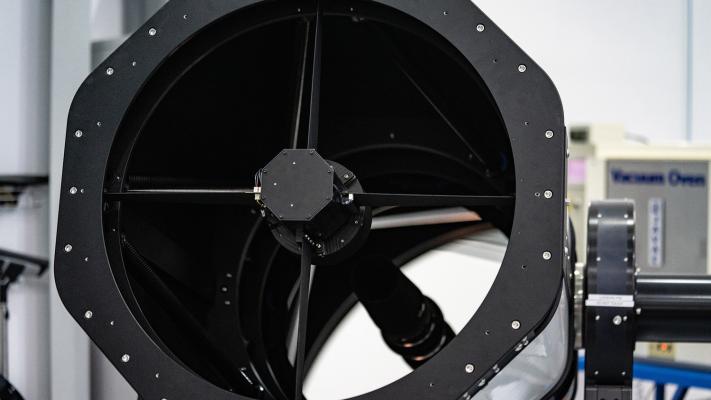
Pictured above: Close-up view of the telescope. Credit: ANU
Industry showcase
Australian space innovations making an impact.