
The National Space Qualification Network (NSQN) is a group of world-class testing facilities across the country, giving Australia and its regional partners a local destination to qualify hardware for space missions.
The remote and extreme nature of space means it’s not easy to predict how advanced technology will fare once it gets there. A lot of specialised testing must be done on Earth, replicating space conditions as closely as possible, to increase the odds of mission success. For Australian companies, this traditionally meant spending considerable time and money sending components away overseas for testing, as they were unable to access space qualification capabilities locally.
In response to this gap, the Australian National University's Institute for Space (ANU InSpace) launched the NSQN in 2023. It provides the local space industry and the Indo-Pacific region with access to $1 billion worth of space qualification infrastructure, for immediate cost-effective testing and accelerated space mission design and delivery. The network was backed by an investment from the Australian Space Agency’s Space Infrastructure Fund.
Led by ANU InSpace, the NSQN operates as a consortium of partners including the Australian Nuclear Science and Technology Organisation (ANSTO), Steritech Australia, the University of Wollongong Centre for Medical Radiation Physics, Saber Astronautics, and Nova Systems.
The testing capabilities cover radiation, vibration, pyroshock, thermal vacuum, electromagnetic interference, systems engineering, and space environment modelling, as well as mission design, assurance, and operations. The Australian National University’s own contribution includes its National Space Test Facility, home to the largest thermal vacuum chamber in Australia, and its Heavy Ion Accelerator Facility, offering some of the world’s most accurate radiation beam control and detection technology.
The NSQN has assisted most Australian space organisations and missions operating in low Earth orbit since its inception – including Fleet Space, Skykraft, the University of Melbourne-led SpIRIT program, and the UNSW Canberra M2 program. Its testing has elevated Australian advanced manufacturing across space-borne solar cells, electronics, materials, and robotics. Meanwhile, the network is also educating and training users, building a knowledge base, and providing information to customers on how testing is conducted.
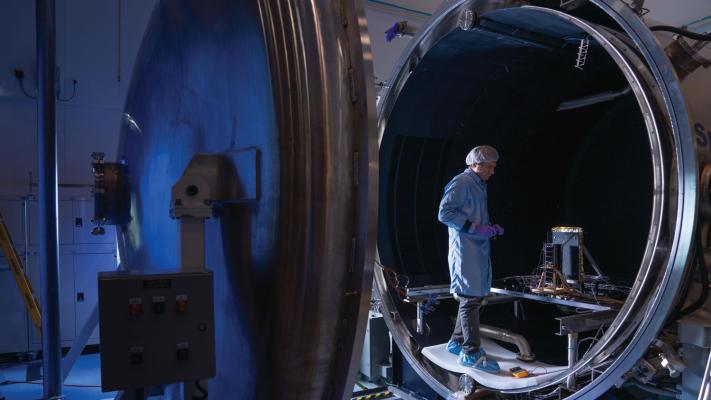
Caption: Staff working with the thermal vacuum chamber. Credit: The Australian National University
“The NSQN offers the ability to uplift the curation, maintenance, and launch of Australia’s sovereign space capabilities… Upgraded facilities will mean we can make sure the payloads we send into space, including satellites and spacecraft, are able to survive before they blast off.”
~ Professor Anna Moore, Director of ANU InSpace.
Technology features
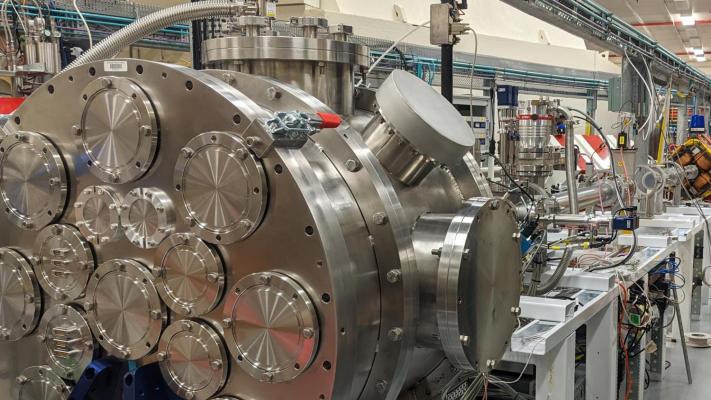
- Australia’s first coordinated radiation test beamline capability – enabling spacecraft electronics and components to be tested and qualified onshore against the radiation environments encountered in space, reducing reliance on overseas facilities.
- Advanced thermal vacuum testing infrastructure that replicates the extreme temperatures and vacuum conditions of space.
- Pyroshock and environmental test systems that simulate launch and spacecraft separation events to verify hardware survivability.
- Qualification capabilities for sensors, robotics, communications, autonomous navigation, power systems, and advanced materials – supporting mission assurance for next-generation space missions.
Pictured above: Inside the Heavy Ion Accelerator Facility. Credit: The Australian National University
Project highlights
- Agency Space Infrastructure grant awarded to develop the network of facilities.
- Creation of a nationally coordinated space qualification and mission assurance ecosystem for Australian industry and researchers.
- Strengthened sovereign capability by enabling many space technologies to be tested, validated, and qualified within Australia, before deployment on domestic and international missions.
- Connection of specialist testing and validation facilities across Australia, providing affordable and accessible pathways for technology qualification and flight readiness.
- Accelerated lab-to-orbit missions through partnerships between ANU, ANSTO, Nova Systems, University of Wollongong, Steritech, and Saber Astronautics.
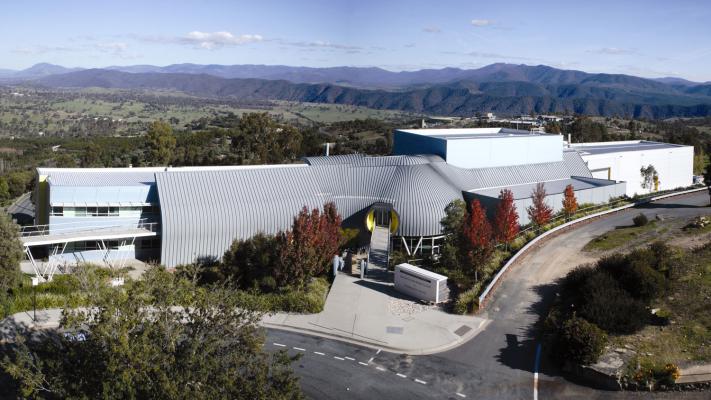
Pictured above: Aerial view of the NSTF at Mount Stromlo Observatory. Credit: The Australian National University
Industry showcase
Australian space innovations making an impact.