
QuantX Labs has created the world's first optical atomic clock for space – a technology that uses the oscillations of atoms to keep extremely accurate time.
Space-based positioning, navigation, and timing capabilities support numerous aspects of daily life – from the practicality of communications networks and transport systems to the protection of emergency services and defence forces. Meanwhile, those capabilities themselves rely on the ability to precisely and securely measure time.
Adelaide company QuantX Labs is renowned for its quantum technology expertise, and its founders initially created and demonstrated a quantum clock at Adelaide University’s Institute of Photonics and Advanced Sensing. With the potential to deliver ten times the performance of current GNSS-based timing systems in space, the company received financial backing – including Australian Space Agency investment – to develop the clock into a space-ready payload.
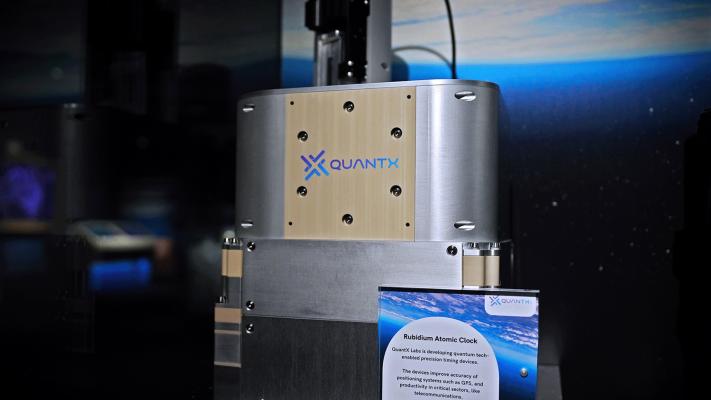
Pictured above: A display model of the TEMPO.Space clock
The result, a clock called TEMPO.Space, loses just one second every 30 million years. Its quantum-powered design provides a secure alternative to current systems, and it’s an effective detector of GPS spoofing and jamming. Plus, as a bonus beyond its timing capabilities, the clock’s deployment in orbit can support deep space communications and synchronised Earth observation. With systems engineering support from Surrey Satellite Technology Ltd (SSTL), the clock is being prepared for launch on a world-first demonstration mission, aiming to set Australia up as a global leader in space-based optical atomic clock technology.
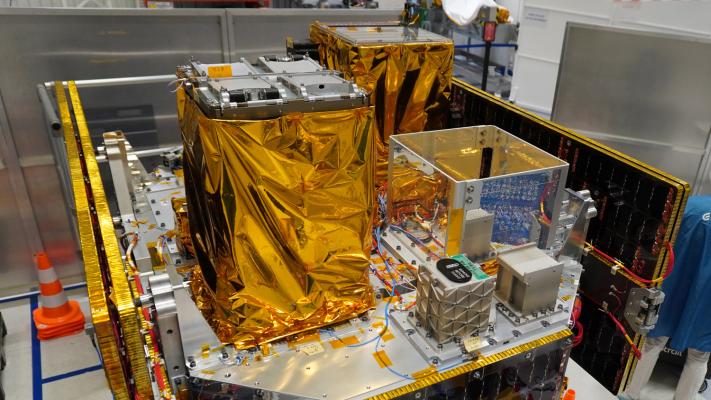
Meanwhile, an important component is already working in space. With a ride aboard Exotrail’s ‘spacevan’ vehicle in March 2026, QuantX launched its TEMPO Optical Frequency Comb – a type of laser for measuring exact frequencies of light, using a technique that won the 2005 Nobel Prize in Physics. The comb translates ultra-stable optical signals into usable electronic timing information, making it a core subsystem of the TEMPO.Space optical atomic clock. The mission success represents the first time an optical frequency comb has been operated in the space environment.
“We believe that this technology will eventually prove to be a benefit to all Australians… we are incredibly proud of what we’ve achieved and excited to see Australia take a leading role in space-based precision timing.”
~ Professor Andre Luiten, Managing Director of QuantX Labs
Technology features
- Next-generation optical atomic clock technology delivering highly stable timing and frequency references for space applications.
- Miniaturised photonic timing and sensing systems designed for integration into future spacecraft and satellite platforms.
- Dedicated clean photonics capability for the assembly, integration and testing of space-ready optical systems.
- In-house thermal vacuum, fibre assembly, and optoelectronic testing capability supporting faster technology development and verification.
- Potential applications across satellite navigation, lunar exploration, Earth observation, and terrestrial precision-timing networks.
Pictured above: Optical frequency comb installed on Exotrail spacevan. Credit: QuantX Labs
Project highlights
- Agency Moon to Mars grant awarded to develop hardware and demonstrate the technology in orbit.
- Established an assembly facility to locally manufacture, integrate, and test advanced space photonics technologies.
- Enabled the assembly of a miniaturised interface module for integration with a commercial spacecraft platform.
- Expanded Australian capability in precision photonics manufacturing, environmental testing, and hardware integration.
- Developed specialist workforce capability and created opportunities for collaboration with Australian space companies and educational institutions.
- Positioned the facility to support future commercial projects and Australia's growing space supply chain.
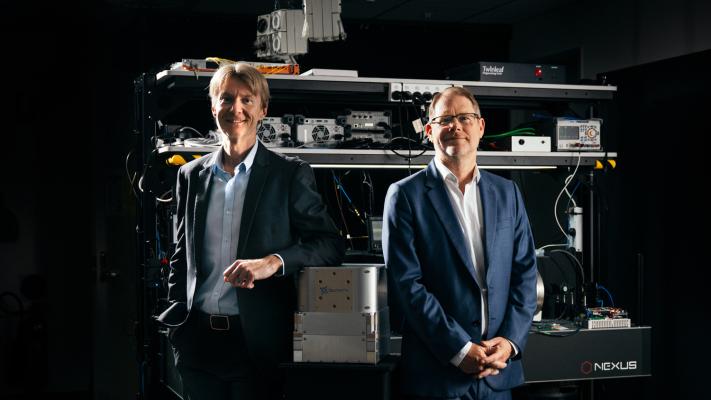
Pictured above: QuantX co-founders Martin O'Connor and Andre Luiten. Credit: QuantX Labs
Industry Showcase
Australian space innovations making an impact.