
Career story
For Jack Rintoul, a career in space began with a conversation.
While studying aerospace engineering, Jack's focus was on aircraft design, aerodynamics and structures. At the time, he hadn't seriously considered a career in Australia's space sector.
That changed when he joined a university mentoring program and was matched with a satellite engineer from Optus. Through their conversations, he discovered the opportunities emerging across Australia's growing space sector and gained a new perspective on where his career could lead.
An internship with Optus soon followed, and the experience confirmed that space was where he wanted to build his future.
After his internship, Jack spent a year with Defence Science and Technology Group, contributing to Buccaneer, an Australian-built satellite designed to test new technologies. He later joined Inovor Technologies as a systems engineer, helping bring spacecraft projects together from concept through to operation.
Working between technical teams and customers to solve problems and deliver mission outcomes became one of the aspects of the role he enjoyed most. It also helped shape his interest in the partnerships and collaboration needed to make complex space missions a reality.
Today, Jack works at the intersection of industry, research and government, helping organisations collaborate to grow Australia's space capability.
Moving into government gave him a broader perspective, allowing him to focus not just on individual space missions, but on how government, industry and researchers can work together to strengthen Australia's space sector.
"The challenges are complex, but success becomes much more achievable when organisations bring together their different strengths."
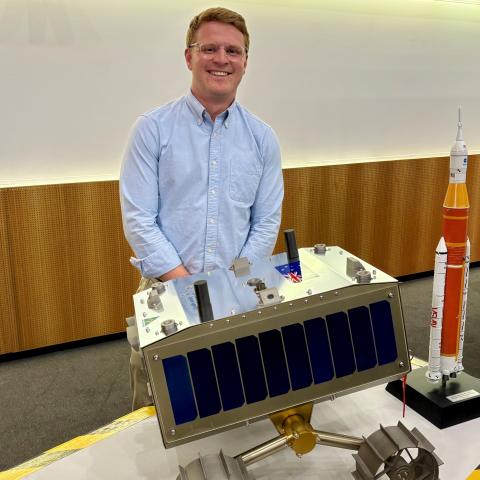
One example, Jack cites, is Roo-ver, Australia's lunar rover, which combines support from NASA, Australian Government investment and expertise from more than 20 Australian companies and universities.
One of the biggest challenges in space is testing technology for environments that are difficult to recreate on Earth. Spacecraft must withstand extreme temperatures, radiation and the vacuum of space, while lunar technologies must operate in reduced gravity.
Facilities such as EXTERRES at the University of Adelaide are helping address these challenges by enabling rover technologies to be tested in conditions that more closely resemble the Moon.
"These capabilities will support future missions and help Australian organisations develop technologies for global space markets."
Jack believes Australian organisations are particularly good at finding practical solutions to complex problems.
Often, innovation comes from using existing materials or technologies in new ways. Through Roo-ver, he has seen universities, researchers and industry partners develop technologies ranging from lunar dust mitigation systems to advanced rover wheel designs.
"When organisations collaborate, each team can focus on what they do best, creating stronger outcomes for the overall mission."
Looking ahead, Jack expects Australia's space sector to continue growing, particularly in launch capabilities, in-orbit servicing and sustainable space operations.
He's also excited by the potential for space technologies to improve life on Earth.
Advances in satellite technology and onboard computing are enabling faster delivery of critical information, supporting applications such as bushfire and flood monitoring, environmental management and communications in remote areas.
"Given Australia's vast geography, improved connectivity and access to space-enabled services has enormous potential to drive innovation across many industries."
For students and early-career professionals considering a future in space, Jack's advice is simple: stay curious and be open to unexpected opportunities.
Throughout his career, Jack has worked across engineering, space monitoring, partnerships and program delivery, with each role providing a different perspective.
"Space careers are incredibly diverse, and no two roles are exactly the same."
He encourages students to look beyond traditional engineering pathways and consider the broad range of skills needed across the sector, including policy, communications, business, law and project management.
Career timeline
Graduated with a Bachelor of Mechanical Engineering (Aerospace) (Honours) from the University of New South Wales.
Industry Experience Program, Defence Science and Technology Group (DSTG). Designed and developed prototypes for secondary payloads for the Buccaneer Main Mission.
Spacecraft Systems Engineer at Inovor Technologies, developing and implementing CubeSat systems engineering methodologies.
Space Systems Engineer at the Australian Space Agency, working to implement space monitoring procedures and technology to monitor objects of Australian interest.
Assistant Director, Space Programs and Industry. Project Manager of the Roo-ver mission.