An institute named after one Australian space trailblazer is helping prepare another to roll smoothly across the surface of the Moon.
Key facts
Key facts
- The Andy Thomas Centre for Space Resources at Adelaide University is handling mobility testing for the Roo-ver program with a special lunar testing facility.
- The facility features pits of replica lunar soil connected to a world-class system that simulates lunar gravity, challenging vehicles to operate without getting stuck.
- A two-week testing campaign is shaping the direction of the ongoing Roo-ver design development, with more testing still to come.
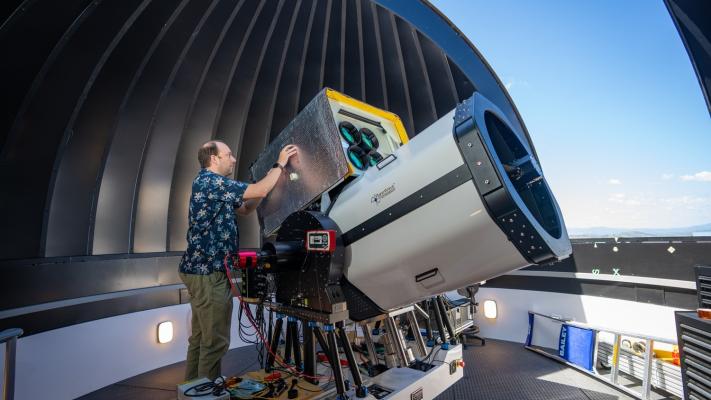
Since 1883, Australia’s first agricultural college has proudly stood in the town of Roseworthy, about 50 kilometres north of Adelaide – though you could argue the distance is more like 384,000 kilometres.
That’s because the campus is now home to the Extraterrestrial Environment Simulation (EXTERRES) Covered Regolith Analogue for Testing and Experimental Research (CRATER) facility, a world-class surface simulation of the Moon.
Established by present-day campus owners Adelaide University, CRATER has become an integral part of the program to develop Roo-ver, Australia’s first lunar rover.
The Roo-ver program is a partnership between the Australian Space Agency and a consortium co-led by EPE Oceania and Lunar Outpost Oceania.
A unique testbed
The facilities at Roseworthy are run by the Andy Thomas Centre for Space Resources (ATCSR), a division of Adelaide University dedicated to researching sustainable space exploration and use of in-situ resources.
The CRATER facility was launched in 2024, and has progressively installed a range of world-class infrastructure to support lunar rover testing programs like Roo-ver.
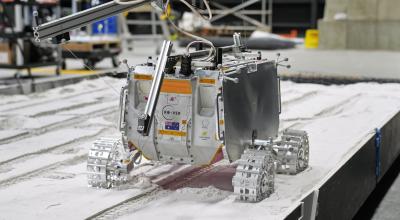
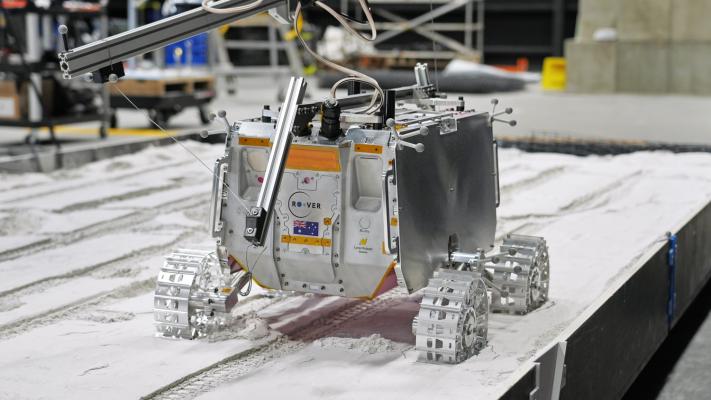
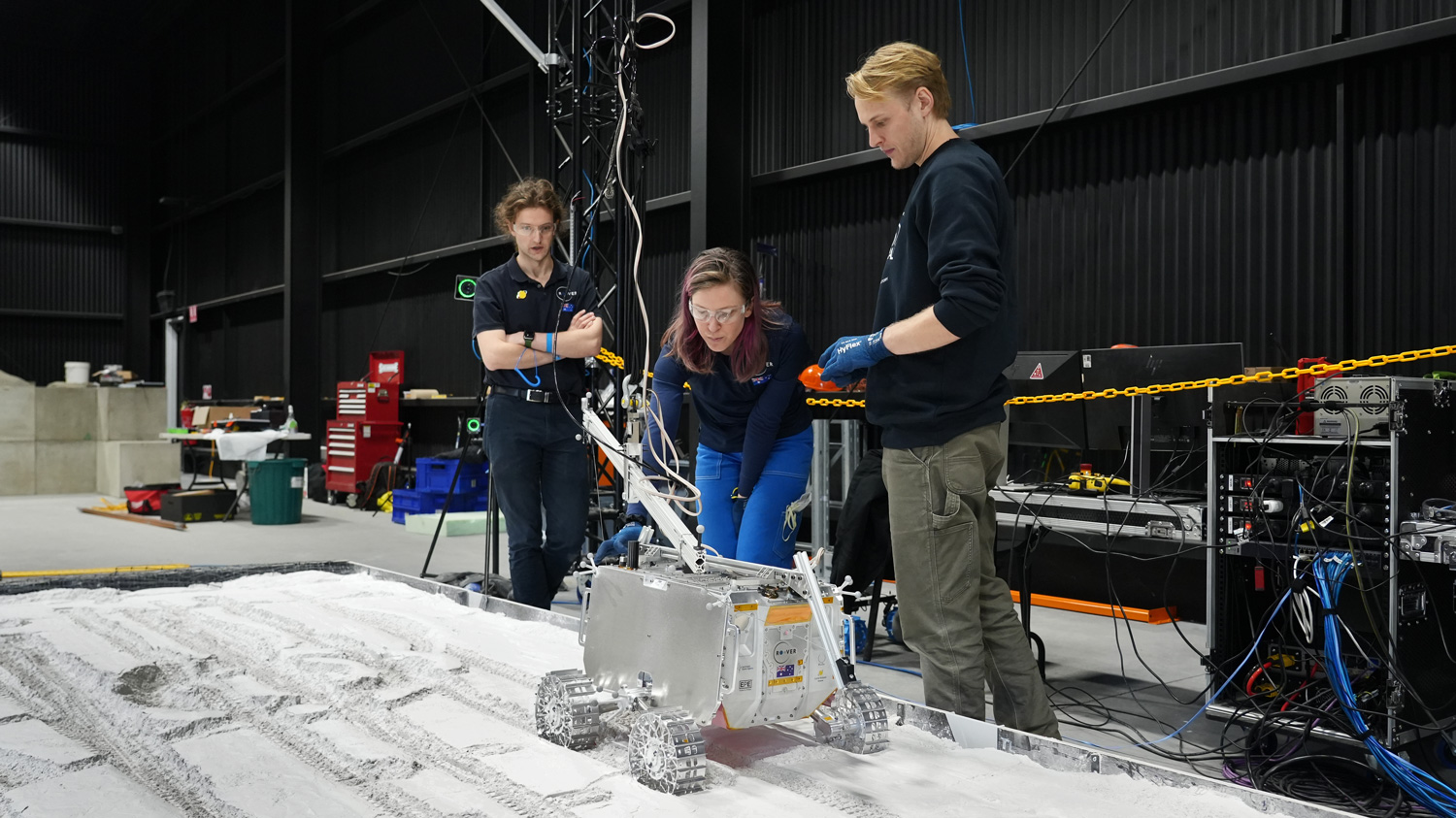
Adelaide University is a member of the consortium developing Roo-ver, and in August 2026, an expert team ran two weeks of mobility testing at the CRATER facility with a new prototype of the rover design.
Katie Doyle, Roo-ver Technical Director at Lunar Outpost Oceania, says the main aim of testing at CRATER is understanding how Roo-ver can best navigate lunar obstacles within the limits of its motor power and wheel manoeuvrability.
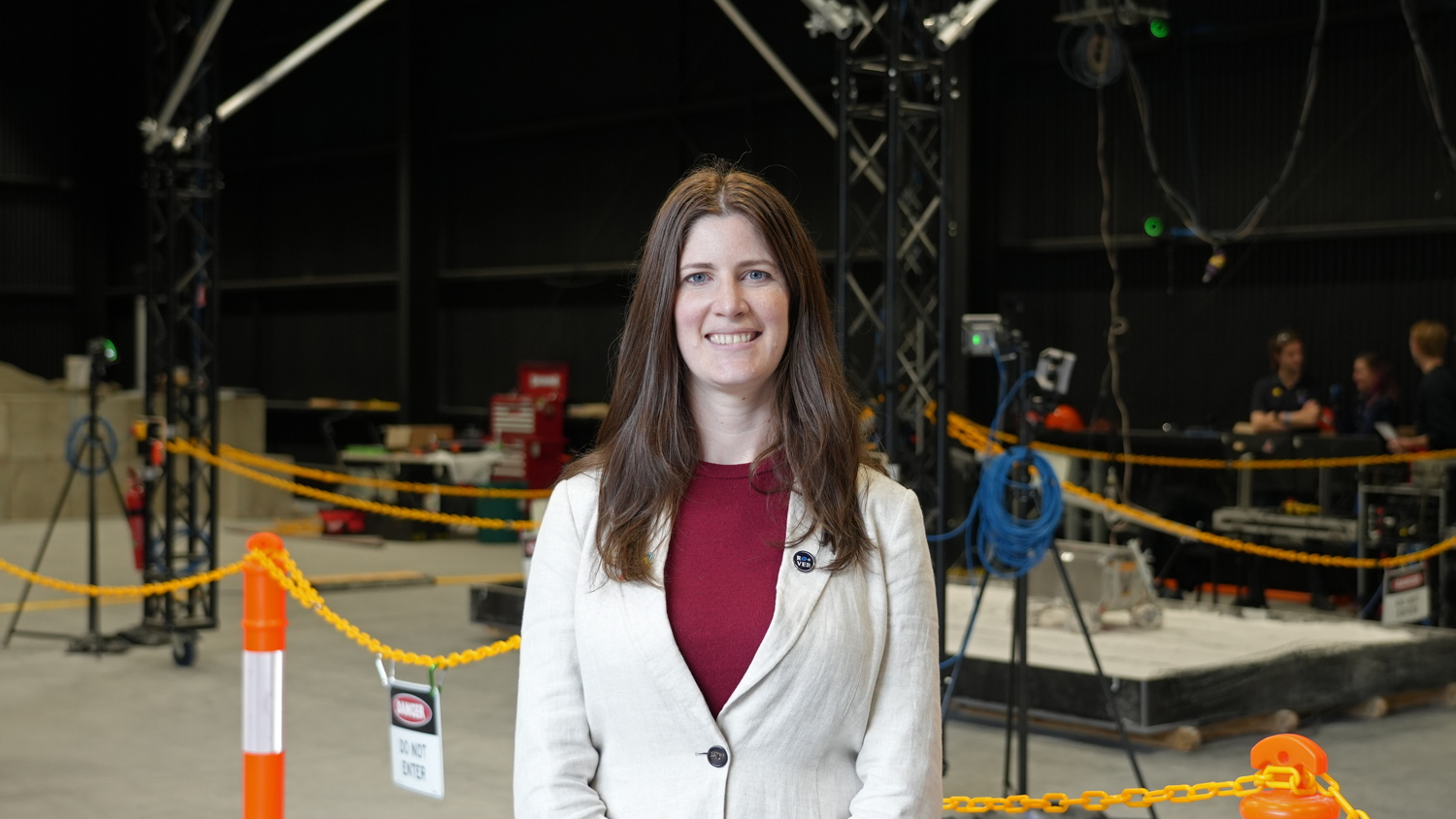
“Up there, there's no one who's going to be able to pick it up and move it around, so we need to make sure it doesn't get stuck,” Katie says.
“We need to know under what conditions it could get stuck… on a rock, or getting bogged, or being unable to go up a particular slope and getting stuck there at the bottom of a hole with that slope all around it.”
Adelaide University is a member of the consortium developing Roo-ver, and in August 2026, an expert team ran two weeks of mobility testing at the CRATER facility with a new prototype of the rover design.
Specialised soil
The first step in getting the lunar simulation right is the surface itself, which on the Moon is made up of soil known as ‘regolith’.
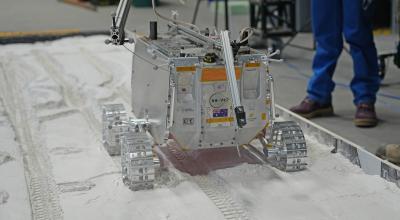
Two types of imitation regolith called ‘simulant’ are used at the CRATER facility, in two different testbeds; one is an industry-standard simulant imported from US company Space Resource Technologies, useful for testing basic physical interactions with Roo-ver.
The other is LLD-1, a special lower-density formula developed in-house at the ATCSR, with behaviour that more closely mimics the effects of reduced gravity on the Moon.
Dr William Foster-Hall, an Adelaide University postdoctoral research associate at the ATCSR, says the LLD-1 simulant is prepared using a rock crusher to get a distribution of sizes based on sample research from the Apollo missions.
“Particles on the Moon have a specific size distribution – some of them are quite big, a lot of them are very, very small… we try and make sure the regolith we're working with also has that same distribution,” William says.
“We get bags of the raw stock and feed it through a rock crusher… we have a very specific process we put it through to then get a representative distribution of the particles.”
Taking a load off
Then there’s the centrepiece of the facility: the gravity offload system.
This 5m3 gantry looms over the testing area with cables that dangle down and attach to a test subject, lightly pulling upwards to reduce the weight of the test subject on the ground.
The effect is measured to create an accurate experience of lunar gravity – which is one-sixth of gravity on Earth – enabling test subjects like Roo-ver to truly move around as if they were on the Moon.
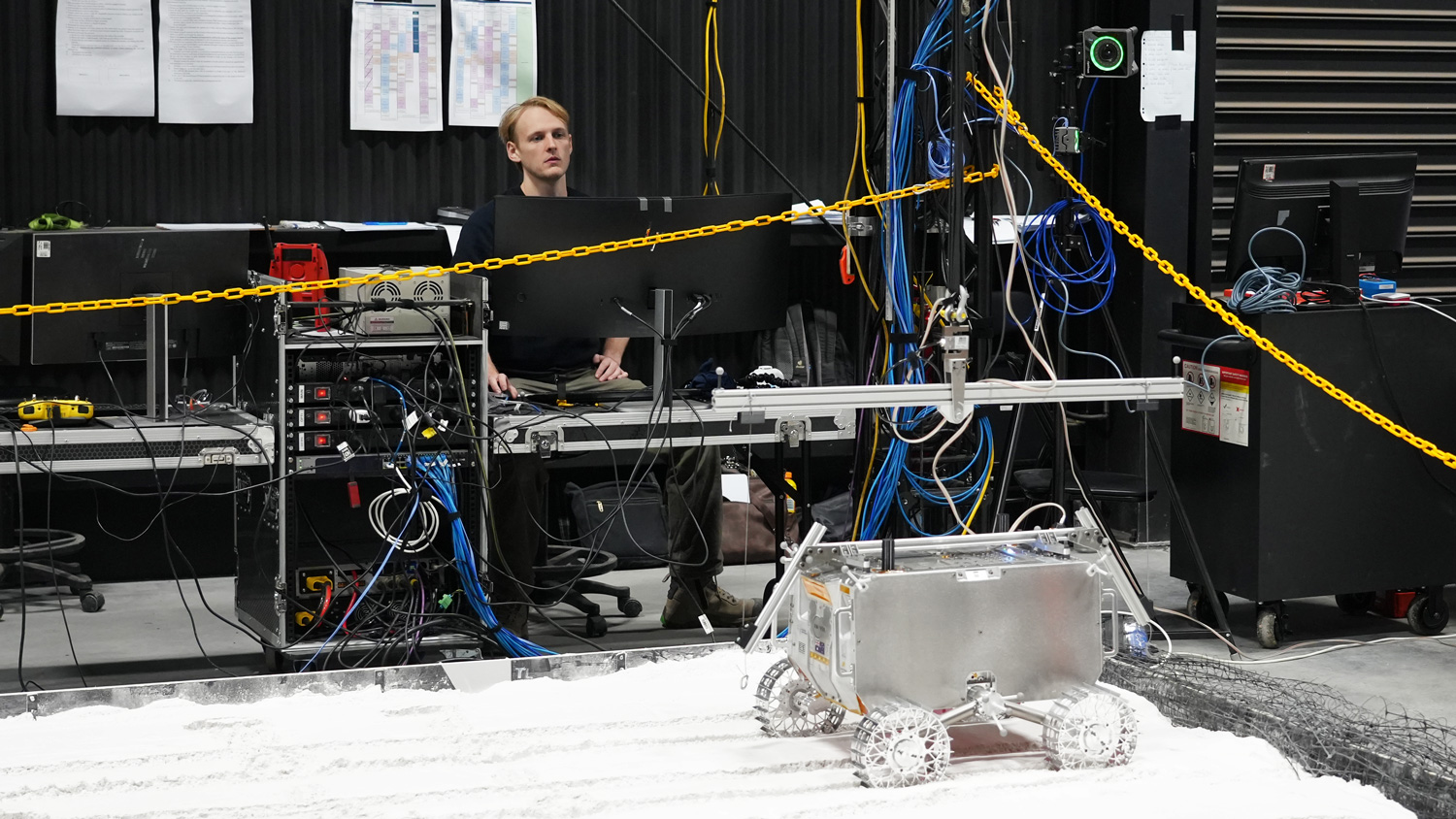
This is a rare capability worldwide, and it’s enhanced with automation software plus a variety of over 20 motion-tracking cameras filming everything.
“You attach these small spherical markers across the system you're trying to track – each camera has an infrared ring light which shines and makes those markers really reflective… the cameras can then take a picture and see where the reflective bits are,” William says.
“The system triangulates all the different markers, and reconstructs the scene in 3D over 100 times per second... it's actually the same principle GPS uses, just on a much smaller scale.”
“We get resolution to one-tenth of a millimetre, which is insane for such a large volume that we're tracking over.”
Positive results to carry forward
The two weeks of testing concluded with terabytes of data – which the team will now refine and analyse to check their observations and get a deeper understanding of the results.
From there, any necessary changes will be incorporated into the design ahead of a new set of prototypes being built next year, ready for more testing to confirm the improvements.
Some of the results are already apparent – and Katie says a key finding was the way the rover sank into the regolith more than expected.
“We found that while we could get over 100-millimetre diameter rocks, the 120-millimetre diameter rocks we kind of got stuck on and got ourselves beached,” she says.
“We're going to have to be really diligent in looking out for those larger rocks and driving around them… we know that now, so we can plan for that.”
As well as this being an avoidable scenario, it was the only one in which the rover got stuck – leaving Katie impressed by the prototype exceeding her expectations in navigating other obstacles.
“I went into this being quite worried that if we did, say, multiple turns in a single spot, especially in the really fluffy regolith, we might dig ourselves into a hole we wouldn't be able to get out of,” Katie says.
“(But) we were able to drive out of it – there was always a way to drive out of it… that gave me quite a lot of confidence in our design.”
William adds that having a 3D reconstruction of the testing now enables the team to alter variables and experiment with different, more extreme scenarios, without the pressure of a time limit in the CRATER facility.
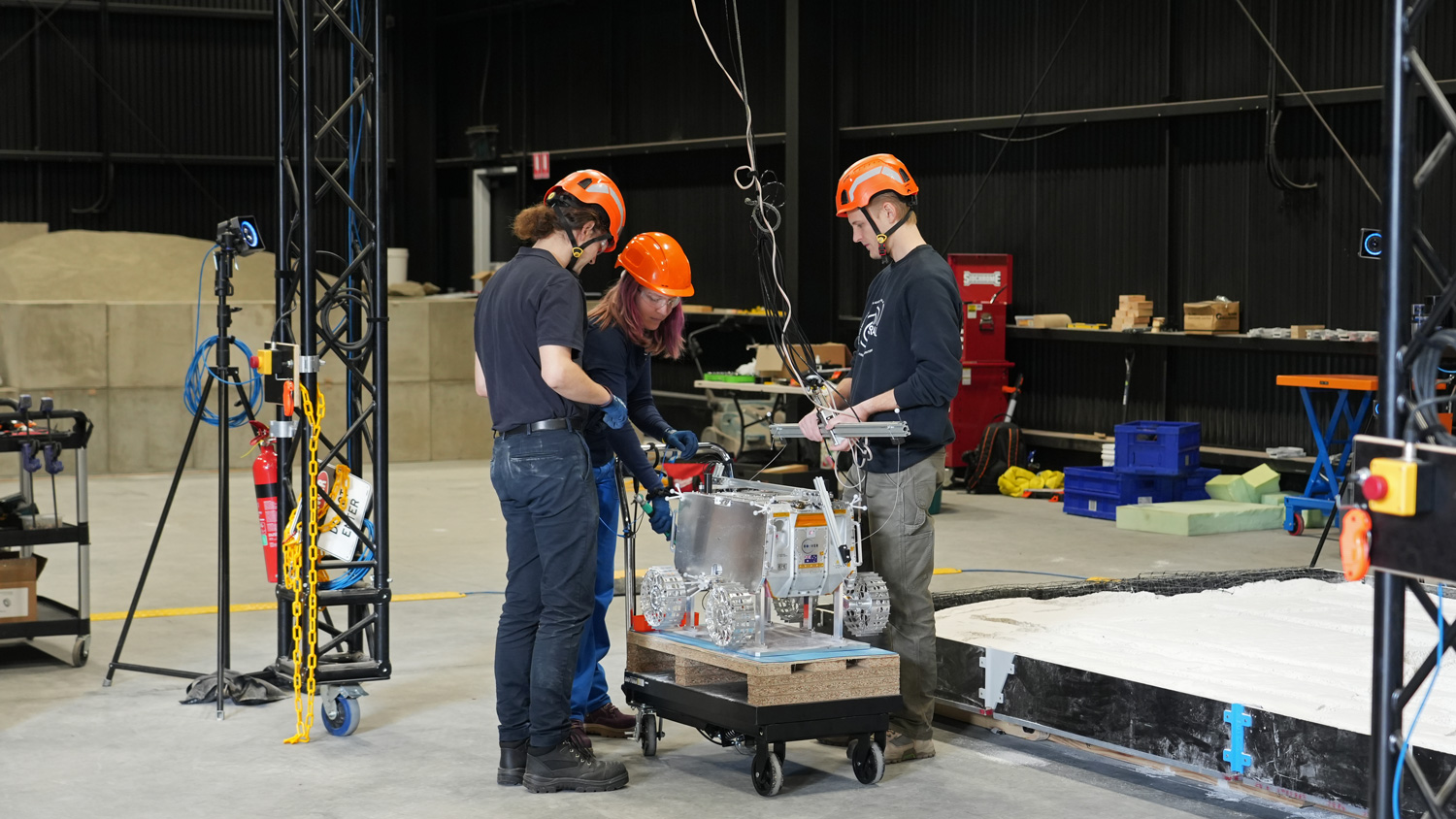
“The point where computer simulations really come into play is... you can't sit there and test everything,” William says.
“We've gathered all this data, and we can feed that into a simulation and then run a lot more tests to evaluate a lot of the other edge cases or combinations of different cases.”
“You know, what happens if you are going down a slope, but there's a rock there… What happens if you're going up a slope and there's a crater… all of those different things are possible now we've done that initial phase of mobility work.”
Success through the process
In developing a lunar rover, the Roo-ver program is demonstrating how well research institutions can work with industry in Australia’s modern space ecosystem.
Adelaide University is one of 10 universities in the nationwide consortium developing Roo-ver, and Katie has seen great value in research ambition combining with commercial pragmatism.
“The universities bring such a thorough approach – wanting to use the absolute cutting-edge from all around the world – whereas industry tends to usually look for already proven systems,” Katie says.
“(So) a really great middle ground of that good, solid innovation, pushing boundaries a little bit while still making sure that things are being done right… that's been a real success story for the university and industry collaboration side.”
Meanwhile, Roo-ver also exemplifies a new wave of domestic space career opportunities afforded to young professionals like William.
“It's an incredibly exciting time… we now have Australia’s first lunar rover, and getting to drive this kind of foundational research on it is a real privilege,” William says.
“Going through undergrad, when the Space Agency was just starting here in Australia, I would have never expected it would lead to this point where we've now got this space ecosystem.”
“I don't think there's anywhere else in the world I could be and get this opportunity that I have right now.”
Industry showcase
Australian space innovations making an impact.
Main image caption: Roo-ver prototype testing at the CRATER facility in August 2026.