
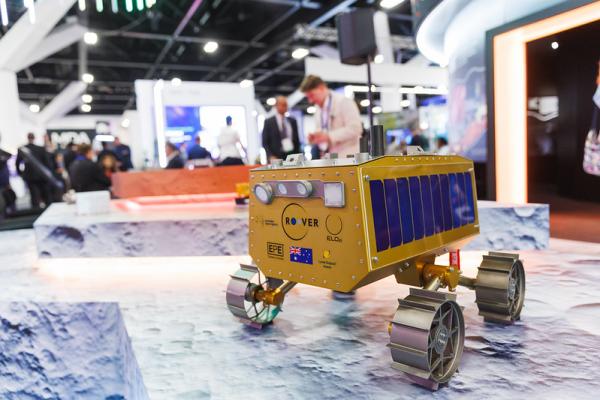
With temperatures ranging from -246°C to 121°C on the Moon, thermal control is critical for lunar vehicles – and after bringing its expertise to the SpIRIT satellite mission, the University of Melbourne is set to manage the temperature of Australia’s first lunar rover.
Key facts
Key facts
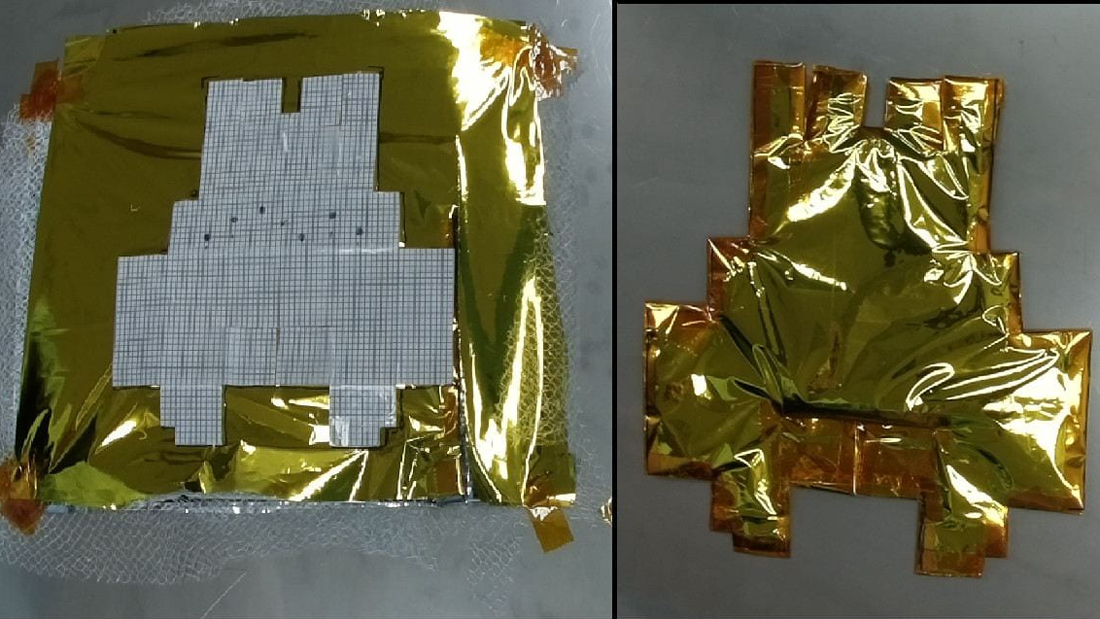
- Melbourne Space Laboratory (MSL) technology will cool Roo-ver’s on-board equipment and insulate the vehicle from extreme lunar temperatures.
- It builds on the success of the MSL-led SpIRIT satellite mission, launched in 2023 with an advanced compact thermal management system.
- Advances in thermal technology can also benefit consumer devices, batteries for electric vehicles and home energy storage, autonomous vehicles, and more on Earth.
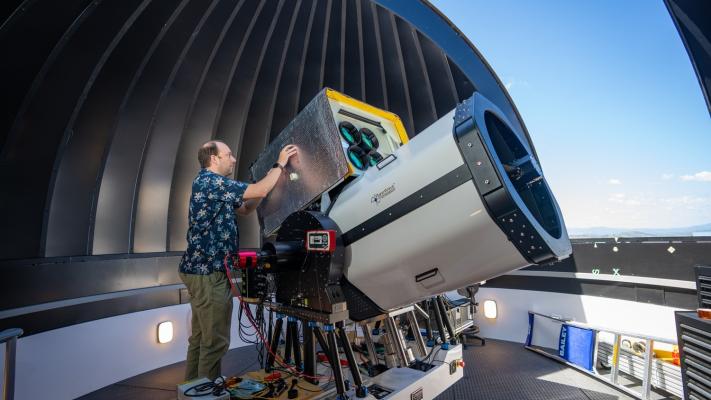
The Melbourne Space Laboratory (MSL) at the university’s Parkville campus hosts a team of emerging and experienced space engineers, working alongside nine other universities in the Australian ELO2 consortium developing Roo-ver.
The MSL launched in 2019 with three focus areas: miniaturised remote sensing, low-latency communication, and compact systems for thermal management of payloads – the latter being key to the success of Roo-ver on the Moon.
The showcase of SpIRIT
To reach orbit, advanced space instruments have long been forced to travel aboard bulky satellites with enough extra room to house traditionally large thermal control systems.
So, by shrinking the thermal control systems, advanced instruments can be accommodated on smaller, more affordable satellites instead – making missions more efficient and accessible.
In 2023, with close to $7million in funding from the Agency’s International Space Investment and Moon to Mars programs, the MSL led the launch of a satellite mission showcasing one of these compact systems.
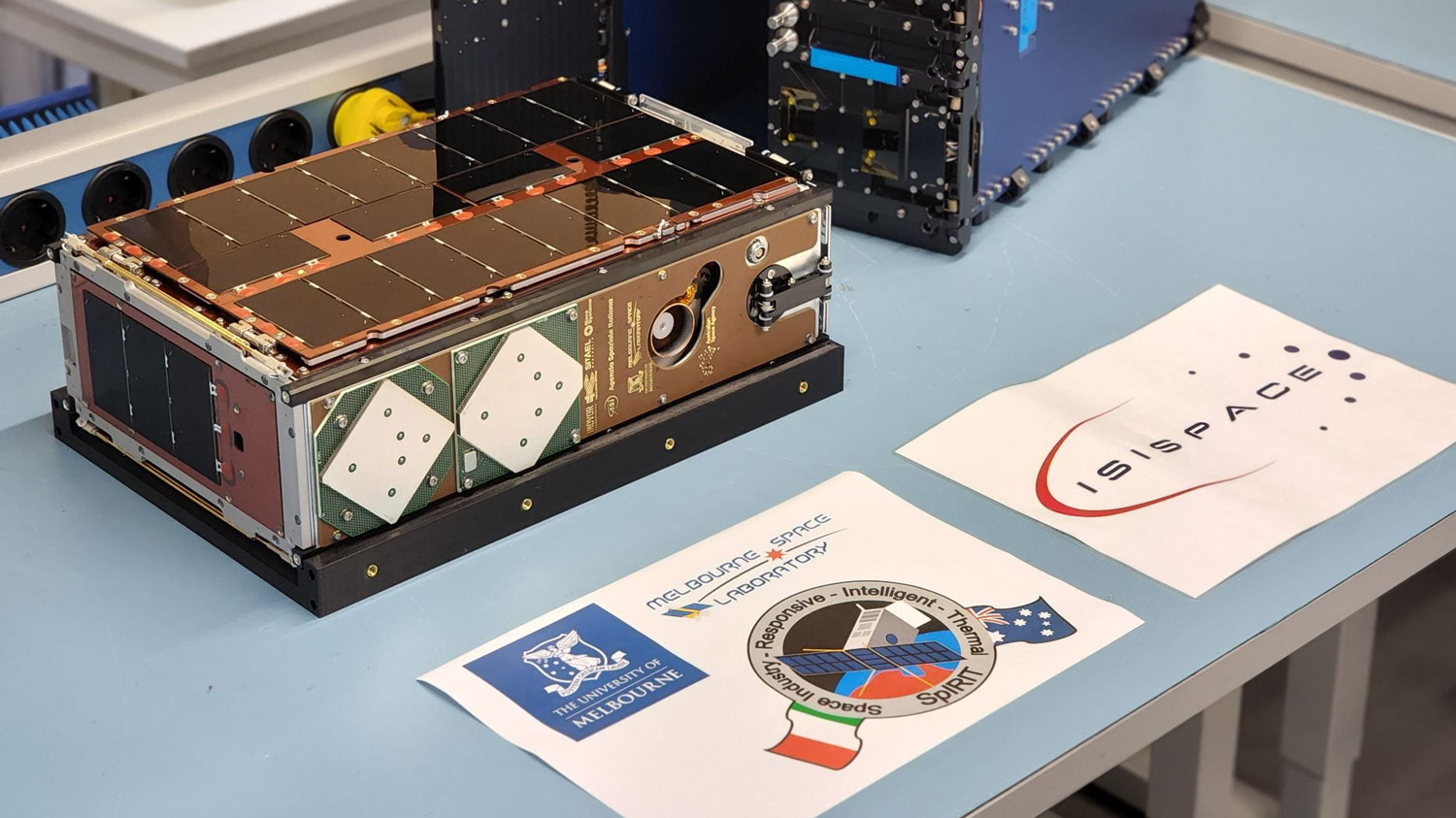
The mission, called SpIRIT (an acronym for Space Industry Responsive Intelligent Thermal), put an Australian-made nanosatellite into orbit carrying a variety of Australian space industry demonstration payloads.
Also on board was the Italian Space Agency’s HERMES scientific x-ray detector, which the University of Melbourne was responsible for thermally managing as it scanned the cosmos for black holes.
Onwards to the Moon
The Moon challenge ahead of the MSL team is a step up from the orbital conditions faced by SpIRIT.
Whereas SpIRIT orbited on a path of fairly stable, predictable thermal conditions, Roo-ver’s journey to the Moon and its cruise on the surface presents an ever-changing variety of thermal demands.
Simon Barraclough, Enterprise Fellow in Space Systems at the University of Melbourne, says a key task will be expelling the internal heat generated by Roo-ver’s on-board equipment – while simultaneously insulating Roo-ver from the external heat of the Sun and the lunar surface.
“In principle, what's inside the rover isn't much more challenging to deal with than a spacecraft (e.g. SpIRIT)… it's how the rover is designed for this wider-range, more extreme environment,” Simon explains.
“The solar arrays, by definition, are designed to absorb light, heat, the sun, because they want to generate power – but then we have a hot surface on the rover.”
“Also, when we go to the lunar surface, we're in a long period of transit – we're attached to the side of a lander, and that lander has other priorities… maybe it’s pointing at the sun for a bit, because they've got to fire the main engine in the right direction.”
“We have to try and work with the system design; thinking how we're positioning equipment in the rover, how we're linking it to external services, and also how we're transferring heat through technology like heat straps.”
Improving thermal technology on Earth
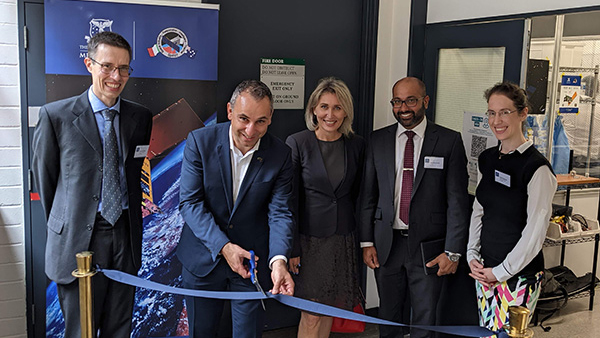
Roo-ver’s thermal management design may be aimed at the Moon – but as MSL Deputy Director Professor Airlie Chapman points out, the team’s work will also create exciting new opportunities for the technology to flow into our everyday lives.
“Thermal engineering ideas help keep phones, cars, medical devices, and power systems from overheating or freezing,” Airlie says.
“Space forces us to design systems that never fail… so taking lessons learned in that mindset into everyday technology increases reliability for everyone.”
“Certain things that are core and critical to space-based missions, like batteries that hate heat and hate cold, appear all over the place – we need long lasting batteries for our future, for electric vehicles, for home energy storage, and for portable electronics.”
“There's this whole area of safer, autonomous systems… in extreme conditions, like in fires, or deserts, or polar regions, or disaster zones, we need to understand how they're going to deal with these kinds of thermal stresses.”
A growing team of expertise
Meanwhile, the MSL project team itself is a great representation of how Australia’s modern space sector is attracting experienced professionals and bringing a new generation of talent through.
Professor Michele Trenti points out that Simon Barraclough comes from lead roles on the European Space Agency’s Solar Orbiter and LISA Pathfinder deep space missions, while research fellow Dr Miguel Ortiz del Castillo designed hardware for NASA’s Mars Perseverance Rover.
“If you look at who is working in the lab at the moment, I think we have one of the most advanced and experienced groups for deep space hardware in our areas of responsibility,” Michele says.
“I think we are really ideally placed to meet this challenge… it's allowing us to really have an opportunity to showcase the expertise we have in the lab, and we're hoping that this is also a catalyst for giving us more research projects and more opportunities to engage with industry.”
PhD student Ivan Rodriguez Mallo, who is one of the emerging Australian professionals on the team – and who returned from overseas to join MSL – says he feels the international attraction of the Roo-ver project.
“A lot of other countries have highly developed space industries, and Australia is definitely trying to compete with that – they're the small industry coming forward, but they're coming in strong,” Ivan says.
“I think this project is a great enhancer for that… it's going to draw a lot of people into Australia to work and become professionals in the space sector, as I'm doing at the moment.”
“It really is expanding the attraction that Australia has for space, and the more people we get in, the more we can develop those capabilities and compete with the rest of the world.”
Echoing Ivan’s sentiments about the significance of the Roo-ver mission for Australia’s space sector, Professor Airlie Chapman is excited to see the project open doors for the nation.
“Very few countries have ever driven a robot on another world… this puts Australia in a very small, very exclusive, capable group of nations,” Airlie says.
“The hope is once you can keep a rover alive on the Moon, people trust you with a bigger mission… it's a proof of deep technological maturity that it’ll be demonstrating.”
“This is a real space mission, and there's no reset button, there's no second chance – that's a lot of pressure… but also a lot of achievement comes with that, and the responsibility is something I think we're pretty privileged to have.”
Industry showcase
Australian innovations making an impact.
Main image: A prototype of Roo-ver at the 76th International Astronautical Congress was held in Sydney.