Mission complete.
Australia has marked a major milestone in its rapidly growing space sector with the successful conclusion of the SpIRIT mission — ending more than 25 months of pioneering operations in orbit and vital demonstrations of our nation’s space capability.
SpIRIT — Space Industry Responsive Intelligent Thermal — is led by the University of Melbourne, in collaboration with the Italian Space Agency, and made possible through investment from the Australian Space Agency. The novel nanosatellite received $7 million in funding from the Agency and exceeded its original two-year design life.
Over its lifetime, the 11.5-kilogram shoebox-sized spacecraft completed about 16,000 orbits of Earth – travelling around 690 million kilometres in total, equivalent to the distance from Earth to Jupiter.
SpIRIT proves Australia can deliver in orbit
This ground-breaking innovation strengthened Australia’s space capability by demonstrating Aussie-designed spacecraft technologies in orbit as well as advancing high-performance autonomous operations, communications and thermal systems.
The nanosatellite's Australian consortium partners included Inovor Technologies supplying the satellite bus, Neumann Space providing its solid metal-fuelled Neumann Drive electric propulsion system, Nova Systems supporting the mission from its Autonomous Intelligent Ground Station, and SITAEL Australia contributing systems engineering expertise.
I’m proud that our investment in SpIRIT has created invaluable space heritage for cutting-edge Australian technology – showcasing what our nation can deliver in orbit, and reinforcing Australia’s position as a trusted international partner on space missions.
~ Head of the Australian Space Agency Enrico Palermo
While fostering close collaboration across industry, government and university partners in Australia and Europe, the mission enabled gamma and X-ray science through the HERMES instrument, a contribution of the Italian Space Agency and its national scientific partners.
In the final months of 2025, the nanosatellite significantly advanced research in high-energy astrophysics. SpIRIT recorded more than 180 hours of X-ray data using its onboard instrument, designed to detect Gamma Ray Bursts – powerful explosions that occur when stars die or neutron stars merge.
Australia's landmark mission in numbers
Inspiring Aussie space
Australia's landmark mission in numbers
Since its launch in December 2023, SpIRIT has:
- Completed about 16,000 orbits of Earth.
- Travelled around 690 million kilometres.
- Downlinked more than 400 images to Earth.
- Recorded more than 180 hours of X-ray data.
Australian‑led, internationally powered
The mission’s Principal Investigator, University of Melbourne Professor Michele Trenti, said the mission had been an incredible achievement for its team and partners.
“We are deeply grateful to the Australian and Italian Space Agencies for their confidence and support, and proud of SpIRIT’s enduring contribution to Australia’s space sector and to the peaceful exploration of space,” Professor Trenti said.
The President of the Italian Space Agency, Teodoro Valente, said the HERMES instrument’s performance demonstrated significant technological progress.
“The successful deployment and operation of the HERMES instrument within the SpIRIT mission marked a significant achievement, both for the validation of the technology and for the achieved high-resolution timing of the measurement,” Mr Valente said.
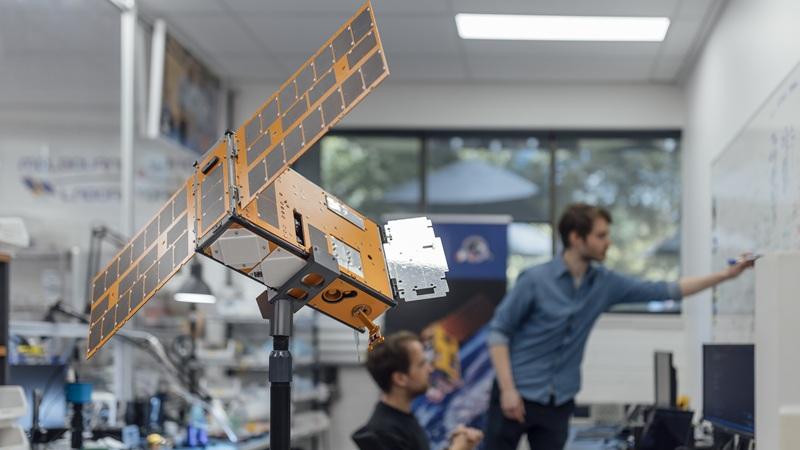
Credit: University of Melbourne
Safe close‑out, lasting impact
In January 2026, the SpIRIT began experiencing platform anomalies and communication was intermittently lost. After careful assessment, the operations team determined that reliable contact was unlikely to be restored, formally bringing the on-orbit phase of the mission to a close.
The spacecraft will gradually descend and is expected to burn up in Earth’s atmosphere around August 2026, leaving no debris behind.
“The final months of operations were highly productive, with payloads performing close to full capability and multiple scientific and technical publications now in preparation,” Professor Trenti said.
Researchers at the University of Melbourne are already analysing and archiving mission data for the broader scientific community, with several research publications already in preparation.
Looking ahead, the knowledge, hardware and partnerships developed through SpIRIT will help shape the next generation of Australian space technologies – from remote sensing to edge computing in orbit.
Industry showcase
Australian space innovations making an impact.
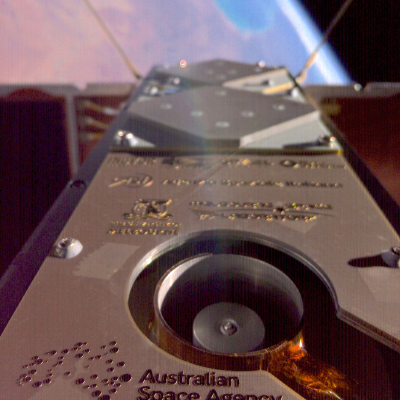
Main image caption: SpIRIT flying over Australia, looking towards the Gulf of Carpentaria and Cape York Peninsula, 42 days after deployment of the selfie camera.
Credit: University of Melbourne