
Magnetic activity on the Sun's surface can create atmospheric events here on Earth, impacting satellites, telecommunications, power grids and other critical technologies. 

These patterns of solar activity are known as space weather. Every day, space weather forecasters use technology to monitor and predict how the Sun will behave.

In this activity from the Australian Space Agency and the Bureau of Meteorology, you’ll use your scientific skills to analyse real solar data and explore how space weather impacts life on Earth.

Learning outcomes

In this activity, students will:

  • Learn about the Sun’s magnetic activity and how it is monitored using space technology.
  • Identify sunspot groups and use them to calculate the relative sunspot number (R).
  • Collect, analyse, and represent sunspot data using a number of digital and analogue tools.
  • Interpret long-term patterns in the Sun’s magnetic activity, understanding that the Sun goes
    through periods of Solar Maximum and Solar Minimum.
  • Discuss the potential impacts of a geomagnetic storm on different areas of society.
     

Australian Curriculum (v9)

  • Science Inquiry
  • Science Understanding
  • Science as a Human Endeavour
  • Processes and Production Skills
  • Measurement and Geometry
  • Number and Algebra
  • Statistics and Probability
  • Geography Knowledge and Understanding

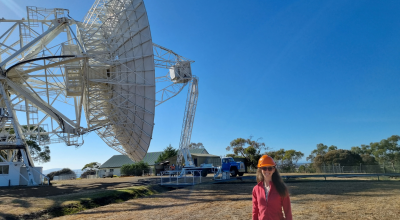
Image credit: Leon Hamilton
Latest from the Australian space sector

Promotional graphic for an event titled space day out that will be held on 19 July.

Special event: Space Day Out

NEWS • Inspiring Australia

28 May 2026

The Agency, supported by Inspiring SA, South Australian Space Industry Centre and Lot Fourteen, will deliver Space Day Out on Sunday 19 July. The celebrations will mark the start of this year's Australian Space Week.

Read more
A visitor interacting with the Buccaneer exhibit at the Australian Space Discovery Centre

New defence satellite exhibit at the Australian Space Discovery Centre

NEWS • Australian Space Agency

25 May 2026

Visitors can learn more about the Buccaneer Main Mission and how this cutting-edge Aussie technology will help us understand how radio waves travel.

Read more
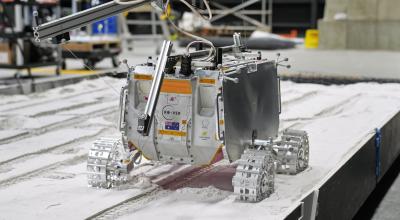
1 (MAIN) - A lunar rover and lunar lander in LunarSim (Element Robotics)

Cruising a virtual Moon

NEWS • Industry showcase: Space spotlight

21 May 2026

Can you imagine driving on the Moon at your office desk? With new simulation technology, Element Robotics is saving missions valuable time and money – and above all, making it easy.

Read more
The next-generation payload

New Myriota IoT payload ready for the market

NEWS • National capability

21 May 2026

To support space missions with Internet of Things communication, the Aussie company will use space-enabled technology it currently provides on Earth.

Read more
Varda-W6-capsule-at-Koonibba-Test-Range

W‑6 capsule safely lands in the South Aussie outback

NEWS • Space activities

20 May 2026

Varda’s spacecraft has landed at Southern Launch’s Koonibba Test Range, highlighting Australia’s growing role as a reliable hub for returns from orbit.

Read more
A SpaceX Falcon 9 rocket, with the company’s Dragon spacecraft atop, launched on Friday, May 15, 2026, from Space Launch Complex 40 at Cape Canaveral Space Force Station in Florida as part of the company’s 34th commercial resupply services mission to the International Space Station for NASA.

Aussie seeds take root at the International Space Station

NEWS • Space activities

19 May 2026

Two plant science payloads led Swinburne University of Technology’s have been successfully docked and integrated aboard the International Space Station (ISS).

Read more

Our department recognises the First Peoples of this Nation and their ongoing cultural and spiritual connections to the lands, waters, seas, skies, and communities.

We Acknowledge First Nations Peoples as the Traditional Custodians and Lore Keepers of the oldest living culture and pay respects to their Elders past and present. We extend that respect to all First Nations Peoples.