Developing food systems for Earth and beyond.
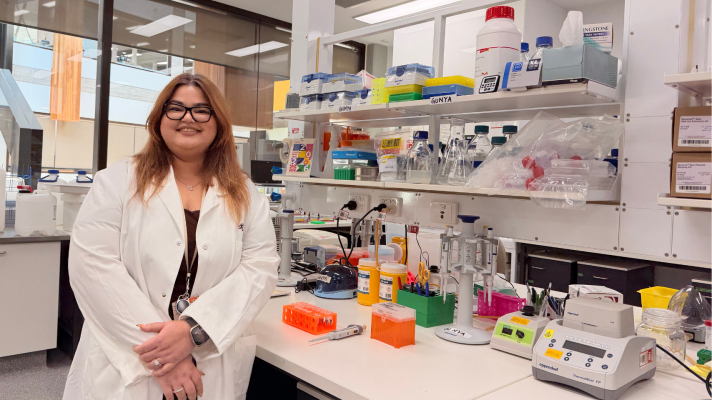
From childhood dreams of space, inspired by NASA astronaut Kalpana Chawla, Gunya Malhotra’s academic journey has been powered by a fascination with plants, medical science and exploration.
Growing up in India, Gunya wondered how plants – despite being unable to move – could sense danger, adapt and survive, and how their compounds might benefit human health.
This curiosity led her to study plant biotechnology and complete a PhD investigating disease resistance in bananas. Along the way, an unexpected finding suggested that altering defence-related genes could also influence plant growth.
That discovery sparked the exciting question at the heart of her research today at Melbourne's La Trobe University: How do plants decide when to grow and when to protect themselves?
The value of space agriculture
Through the ARC Centre of Excellence in Plants for Space, Gunya now studies how tomatoes respond to salt and low-oxygen conditions. Her work could help create resilient crops and resource-efficient growing systems – from Australian farms and remote communities to future spacecraft.
To mark National Science Week 2026, plant scientist Gunya shares with us briefly how she is using space agriculture to develop resilient crops and sustainable food systems for Earth and beyond.
The theme for this year's National Science Week is Seeds of Science: Nurturing science for all. Its designed to encourages young space and STEM enthusiasts to explore how ideas take root, develop and spread – from the first spark of a question to the sharing of discoveries that benefit the wider community.
What can the challenge of growing a single seed in space teach us about protecting food production on Earth?
Growing one seed in space is a deceptively powerful experiment. Away from Earth, every input must be accounted for: light, water, nutrients, carbon dioxide, oxygen around the roots, energy and growing space. Watching where that seed succeeds or struggles reveals what a plant truly needs and how early stress can be detected. Space therefore turns crop production into an extreme test of efficiency.
The same knowledge can strengthen food systems on Earth through precise lighting and nutrition, recirculated water, automated monitoring and protected production where outdoor conditions are unreliable. A seed grown in space is not only preparation for exploration. It can teach us how to produce fresh, nutritious food more reliably, with fewer wasted resources, in a hotter and less predictable world.
What challenges plants face in space and other resource-limited environments, and how can studying their responses help us our crops?
Plants in space face several stresses at once. Microgravity changes how water, nutrients and gases move around roots and leaves; radiation can damage cells; and light, power, water, volume and crew time are all limited. In closed growing systems, poor root aeration, salt accumulation, heat, pathogens and equipment failure can also threaten a crop.
My research asks how plants interpret stresses such as salinity and root-zone hypoxia, then redistribute resources between growth, repair and defence. By identifying the genes, hormones and cellular processes controlling those choices, we can select or develop crops that respond strongly when protection is needed but return efficiently to growth afterwards. That principle matters in a spacecraft, a greenhouse and also a drought-prone field.
How could discoveries from space agriculture make a practical difference for Australian farmers and remote communities?
Space agriculture encourages us to grow more precisely: sensing plant stress early, delivering water and nutrients only where needed, recycling water, and matching light and climate to each crop. These approaches can improve greenhouses, hydroponics and protected cropping for Australian growers facing heat, drought and increasingly variable seasons.
For remote communities, modular controlled-environment farms could supplement existing food systems by producing selected fresh vegetables locally, protected from extreme weather and long transport routes. They are not a universal replacement for field farming, and their energy, maintenance and cost must be carefully managed. The greatest benefit will come from co-designing systems with farmers and communities so that the crops, technology, training and economics suit local needs.
If today’s research is a seed, what do you hope it will grow over the next 10 to 20 years?
I hope it grows into a practical blueprint for producing healthy food where conventional agriculture is constrained, from spacecraft and remote communities to regions disrupted by extreme weather. I imagine resilient crops working alongside efficient, increasingly automated systems that give plants what they need while reducing waste. Researchers cannot achieve this alone.
And what would you say to the young researchers, agricultural innovators and industry partners who could help make that vision a reality?
I want to say to young scientists: stay curious, because one question can redirect a career.
To growers and agricultural innovators: bring your practical knowledge and challenge our assumptions.
And to industry: work with researchers and communities early, so promising discoveries become affordable, maintainable solutions.
The future I want is one in which more people can access fresh, nutritious food, wherever they may live.

Why space matters
Learn about some of the practical, and seamless, ways space technologies is helping us protect Australia's way of life.