Getting Moon-ready.
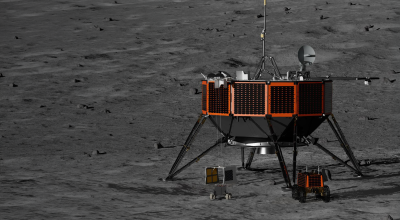
Australia's first lunar rover, Roo-ver, has begun critical mobility testing marking a major technical milestone on its path to a NASA CLPS mission to the Moon’s South Pole region in 2030.
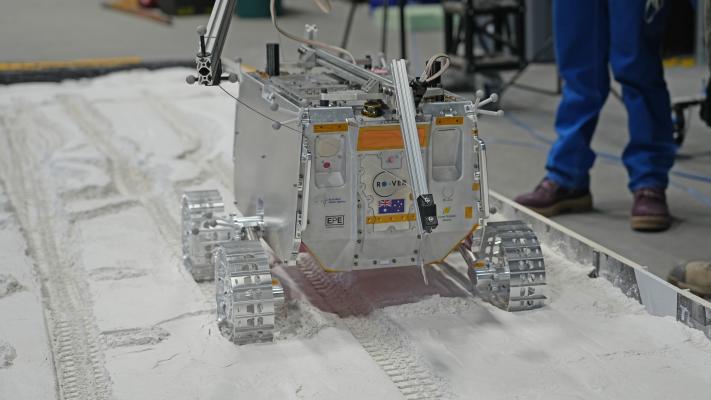
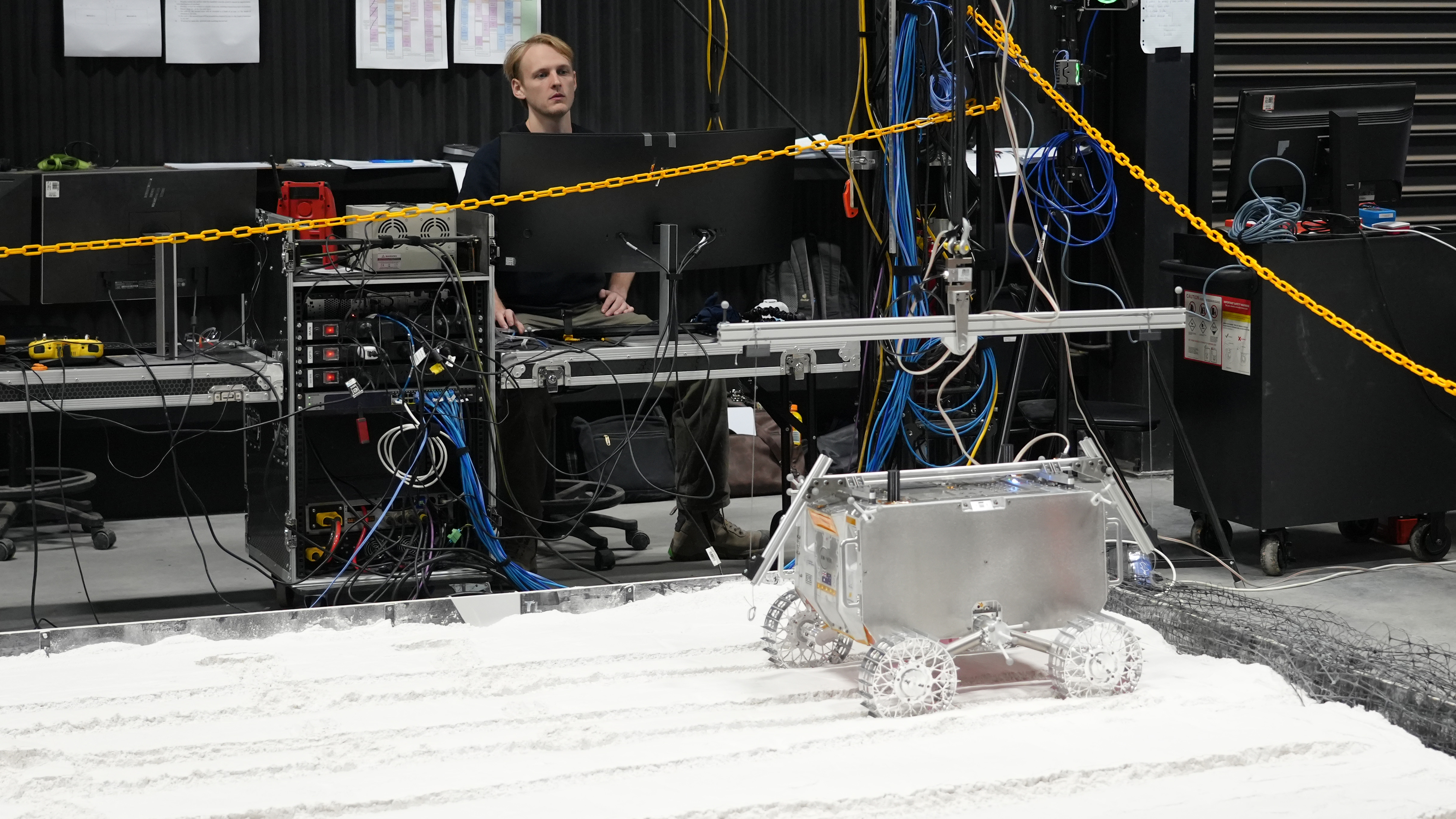
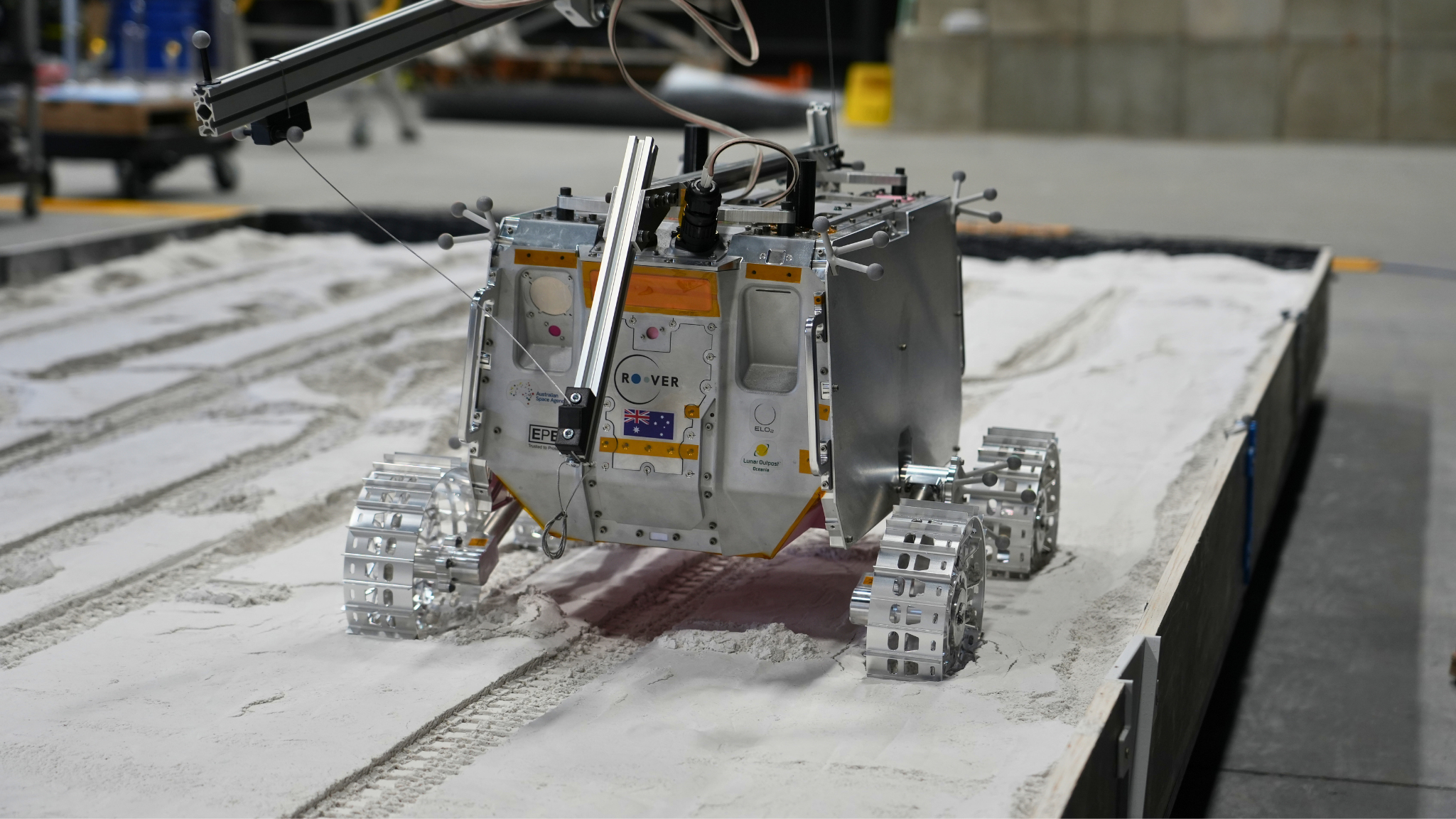
Over the next two weeks, Aussie engineers are putting a new Roo-ver prototype through its paces in one of the most realistic lunar environments at Adelaide University's EXTERRES CRATER Facility, which is part of the Andy Thomas Centre for Space Resources.
Developed by the ELO2 consortium in partnership with the Australian Space Agency, Roo-ver is more than a rover. It is a demonstration of Australia’s growing capability in advanced robotics, remote operations, autonomous systems and space technology.
"The countdown is on for Roo-ver to make its mark on the Moon and write a new chapter in Australian history when it travels to the lunar surface with NASA in 2030.
Roo-ver will also host a NASA payload designed to analyse lunar regolith, contributing to international efforts to build a sustainable human presence on the Moon."
~ Enrico Palermo, Head of the Australian Space Agency
Recently, NASA engineers joined the ELO2 consortium in Brisbane to support the integration and testing of the NASA payload, which is a Multifunctional Nanosensor Platform that Roo-ver will demonstrate on Moon. The visit underscored the international collaboration helping prepare Australia’s first rover to operate on the lunar surface.
Building the next generation of Australian space capability
The critical testing at Adelaide University's EXTERRES CRATER Facility is designed to evaluate how our Aussie rover moves, grips, steers and interacts with the lunar surface.
Every manoeuvre and wheel rotation will help engineers refine the design and increase confidence ahead of the next phase of development.
A successful testing campaign will provide Australia’s first ground-based proof that Roo-ver can drive effectively in a simulated lunar environment.
Why is testing critical for Roo-ver?
Getting Moon-ready
Why is testing critical for Roo-ver?
‣ Testing on Earth is not enough. With lunar gravity just one-sixth that of Earth, every wheel movement, suspension response and manoeuvre must be validated under simulated lunar conditions.
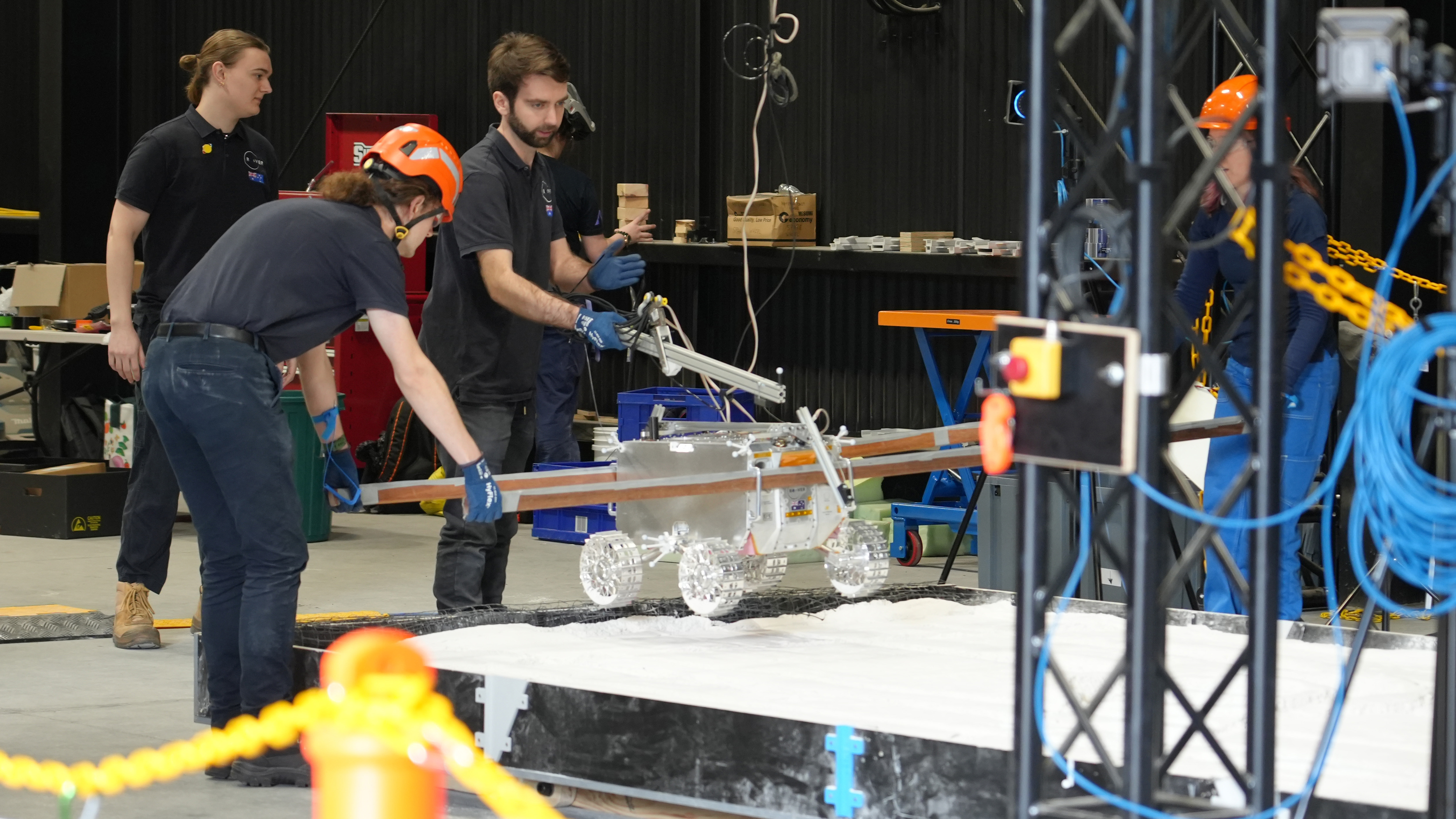
‣ The facility's gravity offload system enables engineers to replicate the reduced-gravity conditions of the Moon, allowing the team to assess performance and refine Roo-ver ahead of deployment.
‣ This is a critical engineering checkpoint before finalising the design and producing a representative engineering model of Roo-ver for more rigorous environmental and flight qualification testing.
‣ While every test provides valuable insights that help improve the rover design and capability, the ultimate objective for the testing campaign is simple: To provide the first major physical validation of Roo-ver ahead of its historic journey to the Moon in 2030.
Critical testing at EXTERRES CRATER Facility
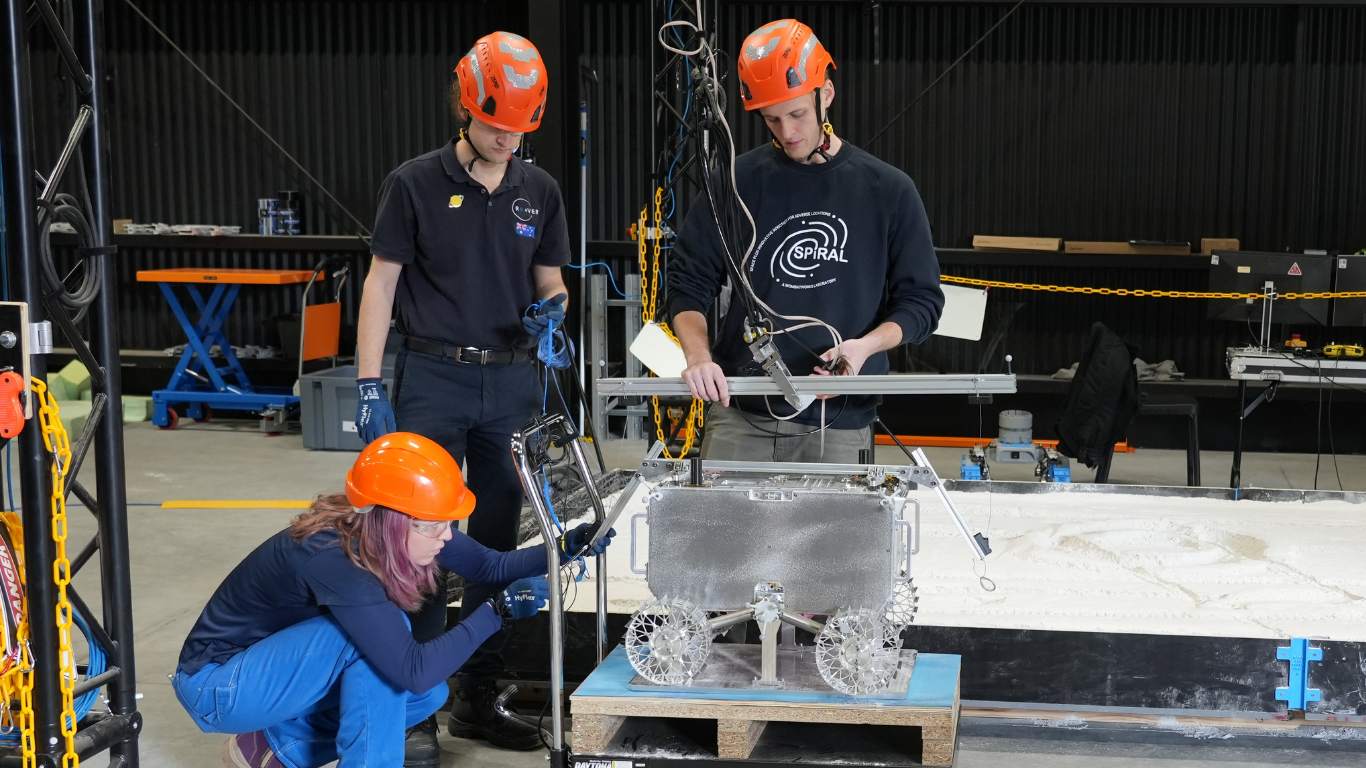
Located at the Roseworthy Campus in Adelaide, South Australia the purpose-built facility features an advanced gravity offload system capable of replicating reduced-gravity conditions.
Combined with high-precision tracking systems and specially developed lunar regolith simulant based on Apollo-era lunar samples, the facility allows engineers to assess how Roo-ver’s wheels, suspension and drive systems will perform on the Moon.
"We'll have less than 14 days to operate on the Moon, so every metre of testing we do here at Roseworthy counts. It's our opportunity to identify and solve problems before we get to the lunar surface.
We're evaluating the rover's performance across rocks, craters and inclines to understand its capabilities and ensure we can operate it safely and effectively on the Moon."
~ Katie Doyle, Roo-ver Technical Director, Lunar Outpost Oceania
A national effort driving Australian space innovation
Roo-ver represents one of Australia’s most ambitious advanced manufacturing and robotics projects to date.
The ELO2 consortium brings together 21 organisations, including start-ups, small and medium-sized enterprises, leading universities and major industry partners.
The collaboration is helping build national capability across Australia's space sector while creating opportunities for the next generation of engineers, scientists and technology specialists.
More than 90 per cent of the program’s budget is being spent in Australia, supporting local suppliers, developing highly skilled jobs and strengthening expertise that extends well beyond the space industry.
Shaping Australia's future on Earth and in space
The technologies being developed through Roo-ver have applications across sectors including mining, resources, agriculture, manufacturing and remote operations, areas where Australia already has global strengths.
This includes expertise in remote and autonomous operations, which have been a key factor in attracting collaboration with NASA, drawing on decades of expertise developed through the nation’s resources sector.
As the countdown to 2030 continues, the latest testing campaign highlights how Australian innovation is helping shape the future of lunar exploration.
From a purpose-built test facility in South Australia to the rugged terrain of the Moon’s South Pole, Roo-ver is providing a powerful example of what can be achieved when government, industry and academia work together.
For Australia’s growing space sector, and the young people inspired to build careers in space and STEM, Roo-ver journey to Moon represents something even bigger: Proof that world-leading space exploration can be designed, built and operated right here in Australia.
Meet Roo-ver
The Australian-made rover that will go to the Moon with NASA in 2030.