Funding lift powers Australia’s next wave of space innovation.
The country’s growing space and space‑adjacent research capabilities are set for a boost, with the Australian Government awarding grants to several universities through Round 2 of Australia’s Economic Accelerator (AEA) Ignite program.
The new funding will help fast‑track 15 innovations into commercial solutions, strengthening national capability and supporting the development of future industries.
AEA Ignite supports projects that build capability in nationally important sectors, aligned with the National Reconstruction Fund Corporation Priority Areas.
By backing early‑stage research in critical national priority areas, including space and its adjacent technologies, the Government is helping position Australia as a global leader in advanced science, engineering and technology.

Get involved
Applications for AEA Round 3 are now open and will close on 4 March 2026.
Space research and development projects
Curtin University
The University's ASTRAPOD project puts the spotlight on autonomous onboard orbit determination capabilities that eliminate ground station dependency while achieving real-time sub-metre accuracy.
James Cook University (JCU)
JCU is developing an AI-powered satellite system to detect Ratoon Stunting Disease in sugarcane. This project falls under a "Sugar-AI" initiative, which aims to improve the sustainability and efficiency of the Australian sugar industry by enabling data-driven agricultural interventions.
Macquarie University
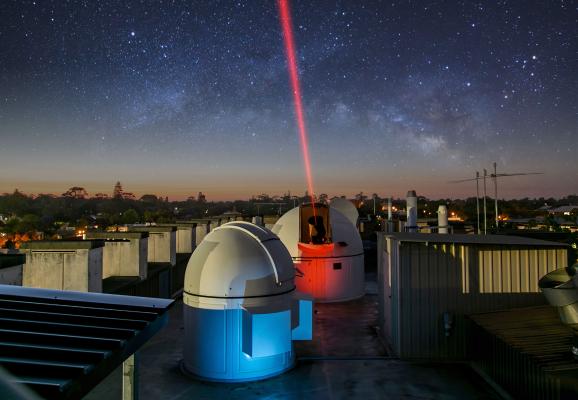
● The University has developed a groundbreaking Diamond High Energy Laser technology designed to significantly advance capabilities in Space Situational Awareness, defence, and quantum science.
● The University's project will develop and run commercial trials of fully functional blue ocean Light Detection and Ranging technology to improve maritime situational awareness in defence and environment settings where satellites and marine buoys are currently used.
● Their third funded project will use drones to characterise satellite and ground antenna systems, enhancing beamforming and polarisation performance.
The Australian National University (ANU)
● The University’s Portable Vacuum Ultraviolet (VUV) Source project is intended to simulate harsh solar radiation to test materials and equipment necessary for space habitation.
● ANU was also awarded an AEA Ignite grant for its ChronoPhase project that focuses on developing advanced picometer-level differential metrology designed for space-based applications, such as inter-spacecraft laser interferometry.
The University of Technology Sydney (UTS)
● One of UTS’ projects is involved in research regarding high-performance space communications, specifically focusing on inter-satellite links.
● The University was also awarded an AEA Ignite grant for commercialising AI-driven Integrated amplifiers for next-generation satellite communications.
● Their third funded project aims to advance satellite computing by developing technology that translates AI algorithms directly into specialised hardware, optimising performance and energy efficiency for space-based applications.
University of South Queensland (UniSQ)
● UniSQ’s project is developing advanced materials (Thulium Oxide Composites) for space-based power generation to improve safety and efficiency.
● The University’s second project aligns with the growing industry demand for thermoplastic composites in aircraft and space-based applications, supporting the need for stringent certification of new, sustainable materials.
● UniSQ was also awarded an AEA Ignite grant to advance sovereign high-speed propulsion for uncrewed aerial vehicles. This project focuses on developing advanced manufacturing techniques for defence capabilities.
University of Queensland (UQ)
UQ has secured funding for a project on composite skins for antenna performance that will enhance aerospace and space structures.
University of Tasmania
The university received its grant for AI-driven space safety sensor fusion research. This project focuses on improving tracking and safety in the space sector through advanced, integrated data technologies.