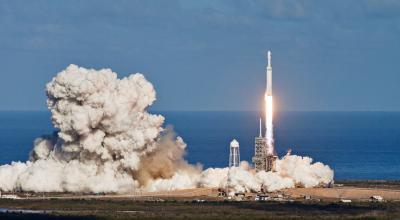

You need an Australian launch permit if you intend to launch a space object from Australia.
A space object is:
- an object (or any part of that object) which is to go into or come back from an area beyond the distance of 100 km above mean sea level; or
- any part of that object, even if that part is to go only some of the way towards or back from an area beyond the distance of 100 km above mean sea level.
The Agency's National Space Security Office (NSSO) can provide advice and guidance on whether you need an Australian launch permit and how to apply.
Process
Acknowledging that an Australian launch permit application requires substantial evidence to satisfy criteria under the Space (Launches and Returns) Act 2018¸ we take an iterative approach to the application process.
Before applying you should read and understand the application guidelines.
You first submit an expression of interest form through the Regulatory Application Hub. You should include supporting evidence demonstrating your current progress against application requirements. We review your expression of interest to determine whether you have sufficient information for the application process to commence.
NOTE submitting an expression of interested is not an application submission. You will need to submit further documents.
During this workshop we:
-
establish the status of your application
-
develop a shared understanding of application requirements that need to be met
-
set and agree application submission and assessment timeframes
-
clarify roles and responsibilities
-
establish principles for how we engage throughout the application and assessment process.
After the workshop we provide you with a copy of a customised application plan which will help guide you through the remaining stages of the application process.
You submit application information in line with your application plan, uploading all documents to the corresponding application in the Regulatory Applications Hub.
We commence assessment of completed information and seek clarification or provide feedback, as required.
During the assessment process we consult with federal, state and territory authorities to see if there is any reason an Australian launch permit should not be granted. Reasons may include Australian security, defence, or international relations.
When there is sufficient evidence you meet criteria for granting a permit, we make recommendations to the Minister (or their delegate).
The Minister (or delegate) decides whether to grant the Australian launch permit, taking into consideration advice from the Agency.
The Minister has discretion to seek further information from applicants and Australian launch permit holders.
Debris mitigation strategy
You must have a debris mitigation strategy if you are launching a space object from Australia.
Your strategy must align with an internationally recognised standard for debris mitigation (examples provided in the Australian launch permit guidelines, above). The strategy must include an orbital debris assessment and outline how you will manage and mitigate the risk of any debris generated (intentional or unintentional) during the lifetime of your space activity.
Costs and timelines
There are no fees for applying for an Australian launch permit, or for having your application assessed.
Application timelines are typically about 6 months from when you have submitted sufficient information to commence the application process.
For more information, download and read the latest guidelines available at the top of this page.
Application criteria include
-
competence
-
environmental approval
-
insurance and financial coverage
-
safety of design, construction, and operation (including flight path) aligning with Flight Safety Code
-
Australia’s security, defence, or international relations
-
whether your object is or contains a nuclear weapon or weapon of mass destruction
-
risk hazard analysis aligning with the Flight Safety Code.
NOTE Criteria relates to launches and any connected returns.
For more information, download and read the latest guidelines available at the top of this page.
Submit your EOI
Find the Expression of Interest (EOI) form at the top of this page
Submit your completed EOI, along with relevant material, via the Regulatory Application Hub