Overview 

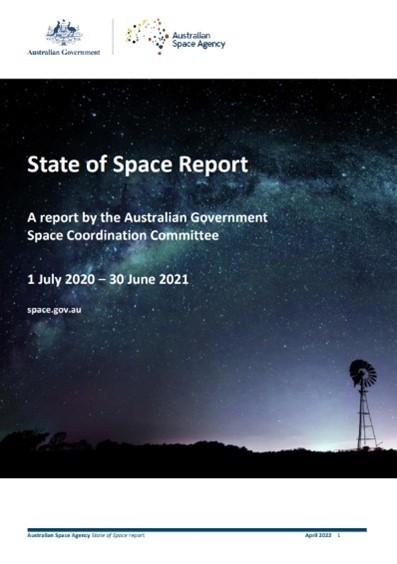
State of Space reports have been published every year since 2014, providing comparative data and insights into the outcomes and progress of the Australian space sector over that period. The insights reported on cover investment and economic impacts, international and national cooperation and collaborations, and other key indicators against the Agency’s strategic pillars.


Resources
2021 in a nutshell

The Australian Space Agency entered into the third phase of the Australian Civil Space Strategy 2019-2020 signified by rapid strides that opened doors internationally and brought new opportunities to the Australian space sector. It also saw the launch of the Australian Space Discovery Centre, central to the inspirational objectives of the Civil Space Strategy.

Key outcomes 

The Agency:

  • moved to Phase 3 of its Australian Civil Space Strategy 2019– 2028
     
  • appointed Dr Megan Clark AC, its inaugural Head of the Agency, to a new role as Chair of its Advisory Board
     
  • welcomed Mr Enrico Palermo as the Agency’s new Head
     
  • joined 7 other nations in signing the Artemis Accords
     
  • supported the recovery of JAXA’s Hayabusa2 sample return capsule
     
  • signed the Australia-UK Space Bridge Framework Arrangement
     
  • began awarding grants under the Supply Chain and Demonstrator programs of its Moon to Mars initiative
     
  • granted its first launch facility licence
     
  • published the first Civil Space Priority Area roadmap, on Communications Technologies and Services
     
  • released its Economic snapshot of the Australian space sector: 2016– 17 to 2018– 19 report as a baseline to help measure future progress
     
  • opened its Australian Space Discovery Centre
     
  • Government departments and agencies are responding to Government investment and new opportunities by increasing their space-related activities.
Latest from the Australian space sector

TEMPOSpace PFM testing_PhotoCredit_QuantX Labs

Perfect timing: Aussie quantum clock innovation becomes a world-first capability

NEWS • National capability

31 March 2026

QuantX Labs launched an optical frequency comb to space — advancing its TEMPO.Space optical atomic clock. This technology is backed by an Australian Space Agency’s program.

Read more
A rendering of the Intuitive Machines larger cargo class (Nova-D) lunar lander with the Australian Space Agency’s Roo-ver lunar rover (lower left).

Aussie Moon rover's journey confirmed

NEWS • Partnerships

28 March 2026

NASA selects Intuitive Machines to carry Australia’s Roo‑ver to the lunar South Pole region in 2030.

Read more
Students must design, test and build a prototype

Young Aussie kids invited to take on Mission: SPACE challenge

NEWS • Inspiring Australia

20 March 2026

Expressions of interest are now open for this national program will be delivered by Scitech and is powered by the Australian Space Agency to shape the imaginations and capabilities of the next generation.

Read more
Chris Shaw, CEO and co-founder of Advanced Navigation with miniaturized inertial system

$50 million NRFC investment for Aussie Earth and space navigation technology

NEWS • National capability

18 March 2026

Funding from the National Reconstruction Fund Corporation boosts Advanced Navigation's valuation to more than $1 billion.

Read more
SLS and Orion lifted off from Launch Complex 39B at Kennedy at 1:47 a.m. EST on Nov. 16, illuminating the night sky. An initial assessment showed the rocket performed with precision, meeting or exceeding all expectations during its debut launch. NASA/Joel Kowsky.

A Century of Lift‑offs

NEWS • Space history and culture

16 March 2026

Robert Goddard, assisted by his wife Esther, sent the first liquid-fuelled rocket aloft on 16 March 1926. Explore with our interactive image gallery how far the technology has come, since he lit the fuse on a tiny rocket 100 years ago!

Read more
space technology

Roo-ver Research: The University of Melbourne

NEWS • Industry showcase: Space spotlight

10 March 2026

With temperatures ranging between hundreds of degrees on the Moon, the University of Melbourne is managing the temperature of Australia’s first lunar rover.

Read more

Our department recognises the First Peoples of this Nation and their ongoing cultural and spiritual connections to the lands, waters, seas, skies, and communities.

We Acknowledge First Nations Peoples as the Traditional Custodians and Lore Keepers of the oldest living culture and pay respects to their Elders past and present. We extend that respect to all First Nations Peoples.