From meat paste in a tube to maple syrup cookies on the Artemis II crew's menu, space food has come a long way since the first human spaceflight in 1961.
Astronauts may be the most fragile “hardware” on any mission, so their meals must be shelf‑stable, lightweight, compact and seriously nutritious – while avoiding crumbs that can drift into vents and switches in microgravity.

In the early days, NASA’s Mercury crews relied on purées, bite‑size cubes and re-hydrated powders. Subsequently, the Gemini missions improved things with freeze‑dried meals re-hydrated via a “water gun” (and yes, Tang helped make fuel‑cell water taste better).  

Apollo then expanded choice and morale: thermostabilised “wet packs”, spoon bowls and hot water meant astronauts could eat warm meals with utensils – closer to dinner on Earth.

Over the 65 years of human spaceflights, longer stays have raised the bar for what was in on the menu for astronauts, including the occasional pizza

Skylab crews even enjoyed freezer treats like real vanilla ice cream, while the Space Shuttle introduced a galley and a menu of around 200 items, plus favourites like tortillas.  

On today’s International Space Station, crews still depend on packaged food, but visiting cargo ships regularly deliver fresh fruit and vegetables.

"Around-the-Moon-meals" during Artemi II helped four astronauts travel the furthest from Earth. The crew rehydrated pouches using a potable water dispenser and warm meals in a briefcase‑style heater – proof that lunar exploration can be demanding and delicious.

The Artemis II menu in numbers

189 unique meals were onboard the mission.

‣ More than 10 types of beverages could be served.

‣ It took 43 cups of coffee to power the Artemis II crew.

‣ The total number of tortillas on the Orion capsule were 58.

‣ There were five different hot sauces that flew with the crew.  

Nine types of culinary flavouring like maple syrup were on offer.

Six types of sweet tooth cravings were available for the crew. 

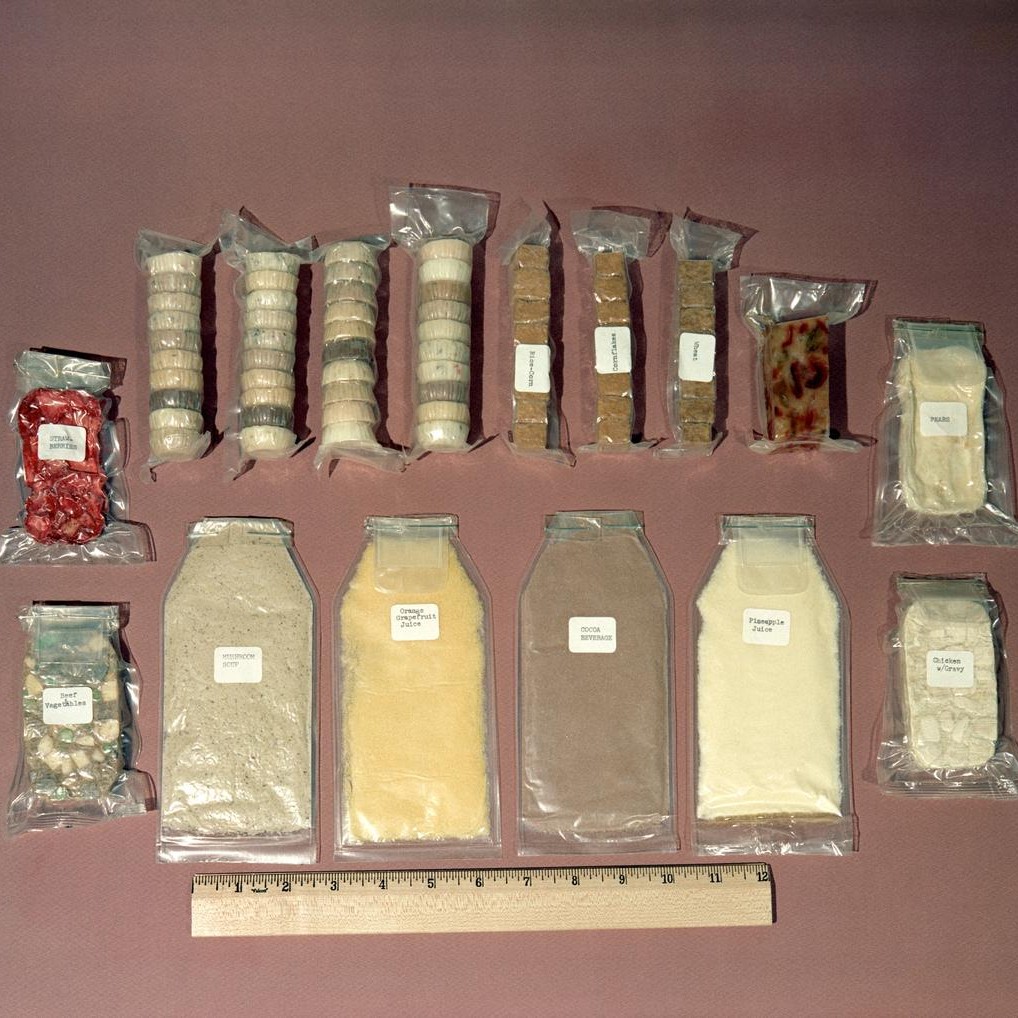
Expand Food kit used by Mercury astronauts. Some is dehydrated and needs water, other packets are ready to eat. Size is measured relative to a ruler. Included are packets of mushroom soup, orange-grapefruit juice, cocoa beverage, pineapple juice, chicken with gravy, pears, strawberries, beef and vegetables and other assorted food containers. Photo credit: NASA

Until the first space travellers proved that they could eat in space, some physiologists thought that it might be physically impossible to swallow in the microgravity environment, or that the body’s normal digestion functions might not work!  For that reason, the first space food was essentially pureed baby food. During his 108-minute flight, Yuri Gagarin, the first person to orbit the Earth, snacked on tubes of beef and liver paste, with a tube of chocolate sauce for dessert. 

The first NASA astronauts also made do with tubes of nutrient-dense purees, bite-sized cubes, and rehydratable soup and drink powders. The menu was very limited, but by the end of the Mercury program in 1963 some dehydrated meals such as beef and vegetables were available. But when most of the meal had to be sucked out of tubes or plastic sachets, eating was not really an enjoyable experience.

Image credit: NASA

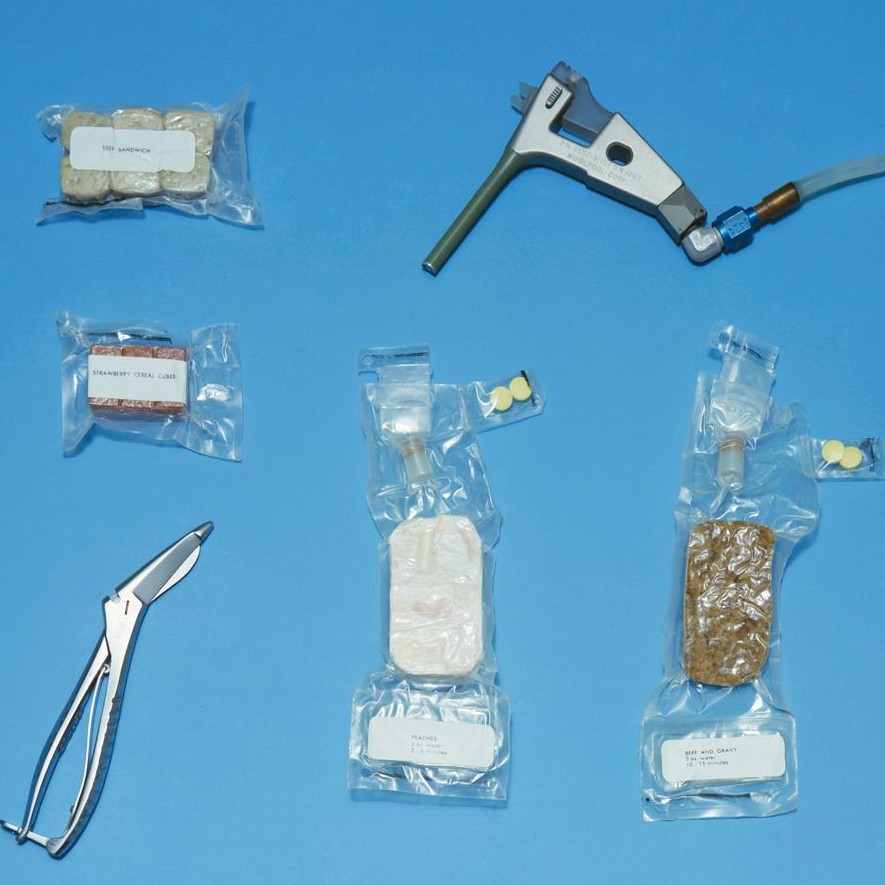
Expand Food packages for use on the Gemini-Titan 4 (GT-4) flight. Packages include beef and gravy, peaches, strawberry cereal cubes and beef sandwiches. A water gun is used to reconstitute the dehydrated food.

The fuel cells used to power NASA’s Gemini spacecraft produced water as a bi-product. Plentiful water (even if it was tepid), the introduction of the freeze-drying technique and improved plastic pouches fitted with one-way valves for rehydration using a water gun, made reconstituting food easier and provided more meal options. Contrary to popular belief, Tang was not invented for the space program, but it was used during Gemini missions to make the fuel cell-generated water taste better.

The two-astronaut crew could select their own meal combinations from a wider range of new menu items including shrimp (prawn) cocktail (still an astronaut favourite!), chicken and vegetables, and butterscotch pudding. Mini sandwiches and other bite-sized snack cubes were coated with gelatine to reduce crumbling, but a prank on the Gemini-3 mission became a problem when a smuggled corned-beef sandwich produced potentially hazardous crumbs. 

Image credit: NASA

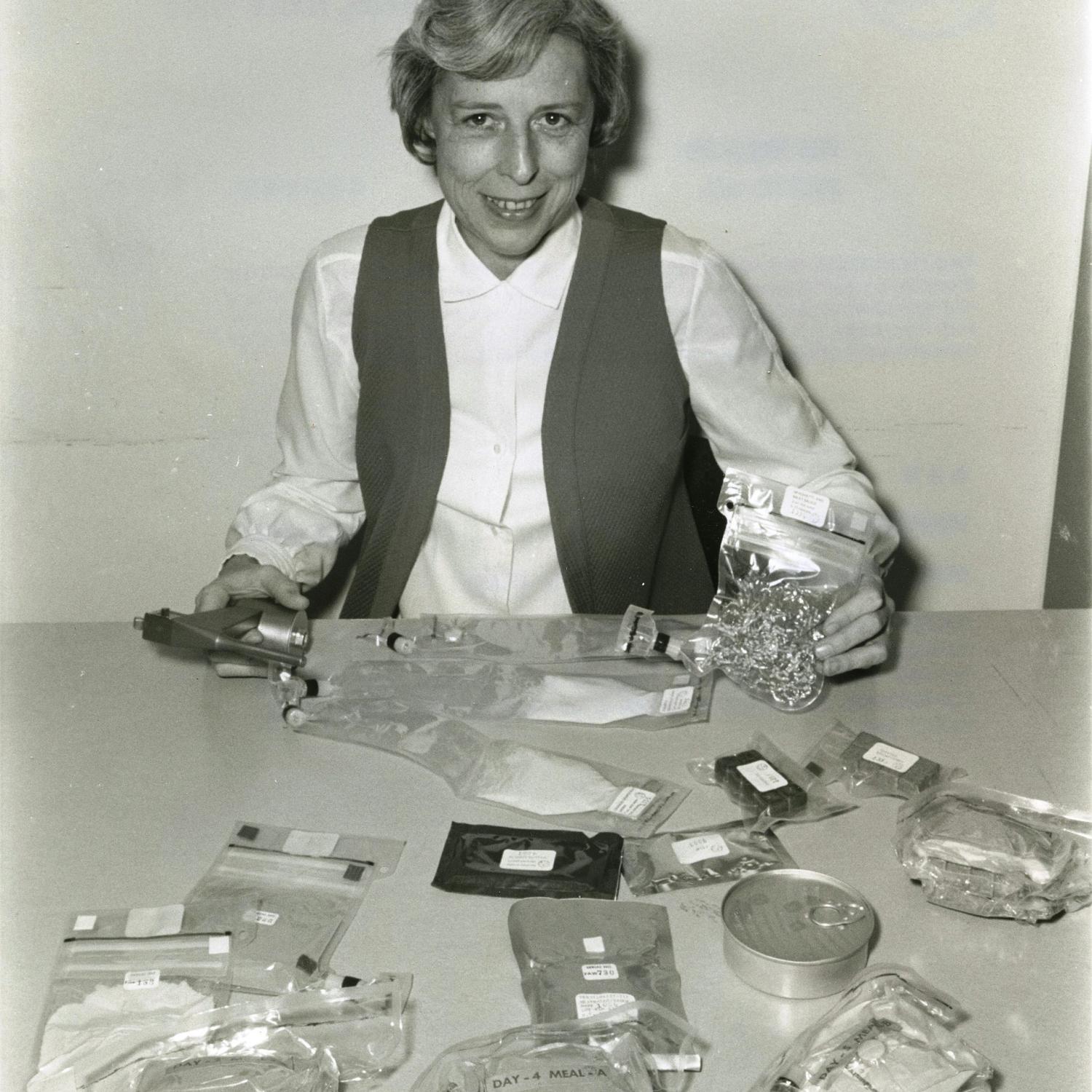
Expand American physiologist Rita Rapp displays the range of food containers used on the Apollo 16 mission.

The Apollo Food Systems team played an important role in improving the quality and variety of space food from the Apollo program to the Space Shuttle. They developed improved means of food preservation, such as thermostabilisation, irradiation and moisture control, which are now used in commercial food production and convenience foods. Using these techniques gave the Apollo crews a menu of around 70 meals, snacks and condiments to choose from

New forms of food packaging, such as spoon bowls, “wet pack” sachets and cans for thermostabilised food, enabled astronauts to eat some meals with spoons. Hot water available in the Command Module made reconstituted food warm, and instant coffee was available for the first time. This more conventional eating experience was good for the astronauts’ morale during missions. 

Image credit: NASA

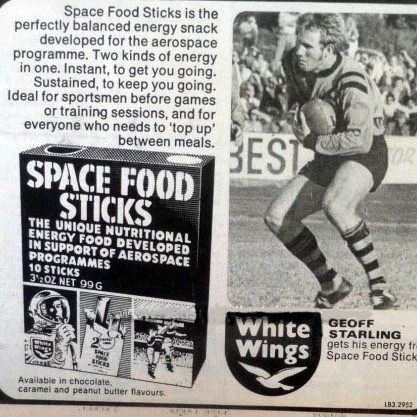
Expand Early promotional advertising for Space Food Sticks, a commercial spin-off from NASA space food. They were particularly popular in Australia.  The launch advertising in Australia described them as “the new ready to eat balanced energy snack that was developed for the astronauts”.

What did the astronauts eat while on the Moon? The Lunar Module menu was basically the same as on the Command Module, with food selections by the mission crew. The first meal eaten on the Moon during Apollo-11 consisted of bacon squares, peaches, sugar cookie cubes (an astronaut favourite home-made by Rita Rapp from the Food Services team), pineapple-grapefruit drink and coffee.

During hours-long Moonwalks in the later Apollo missions, astronauts could chew on nutrition bars fitted into a socket inside their helmets. These chewy snacks came in six flavours (including chocolate, cherry and peanut butter) and were the precursor to today’s energy bars. Marketed commercially in many countries as Space Food Sticks, these snack bars were popular in Australia, on sale between 1971-2014, longer than in any other market.

image credit: australianfoodtimeline.com.au

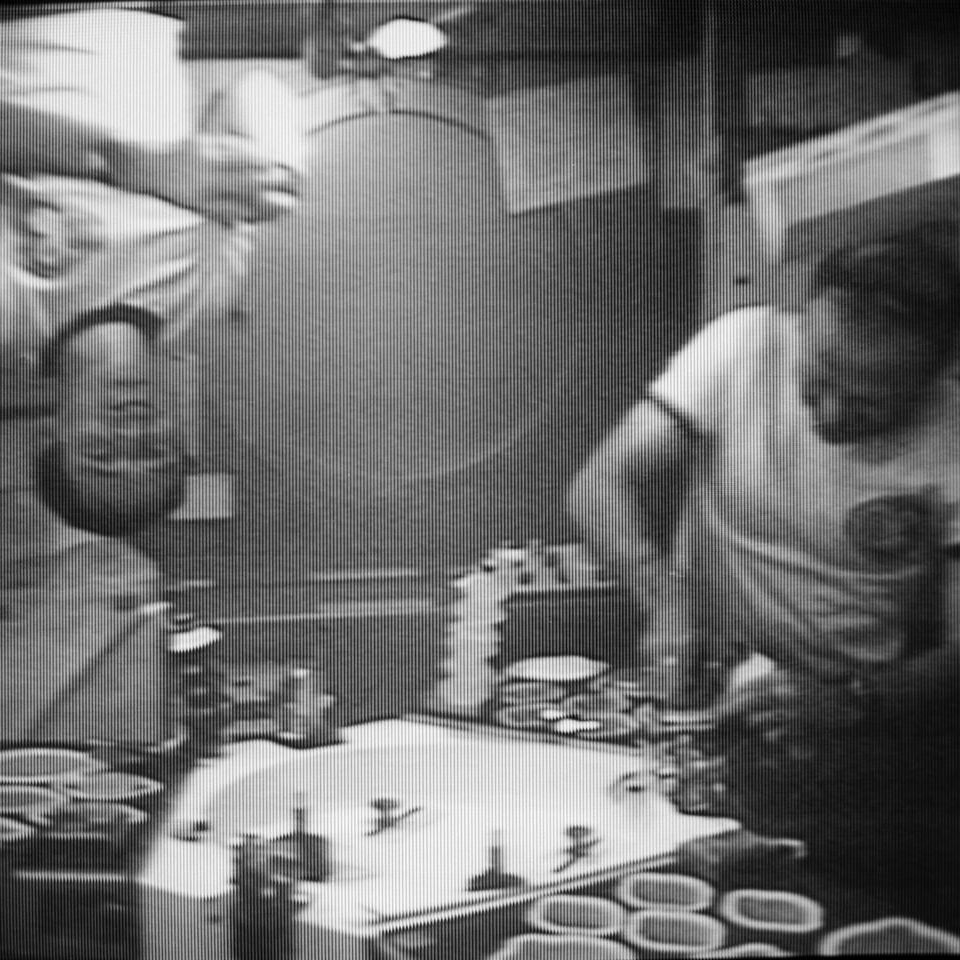
Expand Astronaut Ed Gibson prepares a crew meal on the Skylab space station. In the foreground you can see the dining table and food warming trays.

Three crews of three astronauts occupied NASA’s first space station, Skylab, for successive visits of 28, 59 and 84 days. In addition to improved Apollo-style food, they enjoyed a freezer pre-stocked with delicacies such as fillet mignon and prime rib dinners, lobster Newburg, and real vanilla ice cream!  (BTW, it’s not clear if the crew of Apollo-7 ever tried the freeze-dried ice cream they carried). The astronauts’ food and drink were fortified with calcium and potassium to replace minerals lost due to the effects of microgravity. 

Frozen, canned and pouched foods could be reheated in personal warming trays and eaten with metal utensils, which improved the long-duration crews’ psychological health. Skylab’s design also enabled them to enjoy something resembling a family dinner, with a small “kitchen table” that became a hub for camaraderie and social life. 

Image credit: NASA

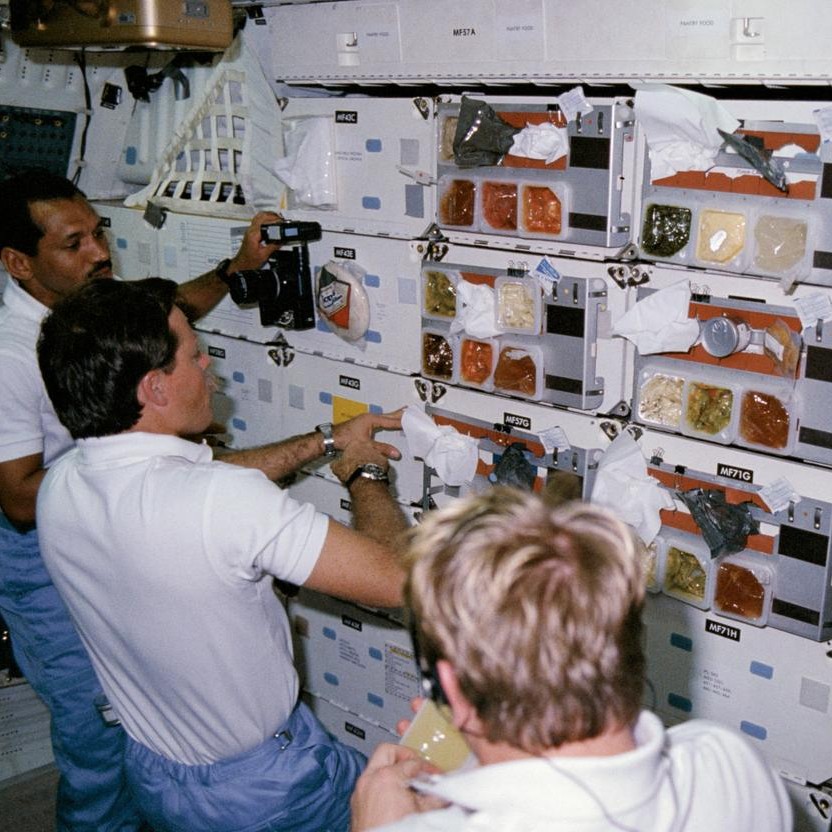
Expand Astronauts queuing at "chow line" on middeck of the space shuttle Columbia.

From 1983, the Space Shuttle carried an onboard galley on most missions. It provided a water dispenser, an oven, stowage for meal trays and a food preparation area. Crew members took turns to prepare meals for everyone, which would take about half an hour to set-up, including heating and reconstituting.  Meal trays were designed to hold different-shaped food and drink containers and made it easy to eat anywhere in the Shuttle. 

The Shuttle menu offered about 200 food, drink, snacks and condiments, many of which were repacked commercial products.  However, with no refrigerator, most Shuttle food items were still dehydrated, freeze-dried  or thermostabilized, apart from a small locker of fresh food to be consumed early in the mission. Astronauts could suggest new food items for their flights, such as tortillas and Hawaiian Kona coffee, which became popular staples. 

Image credit: NASA

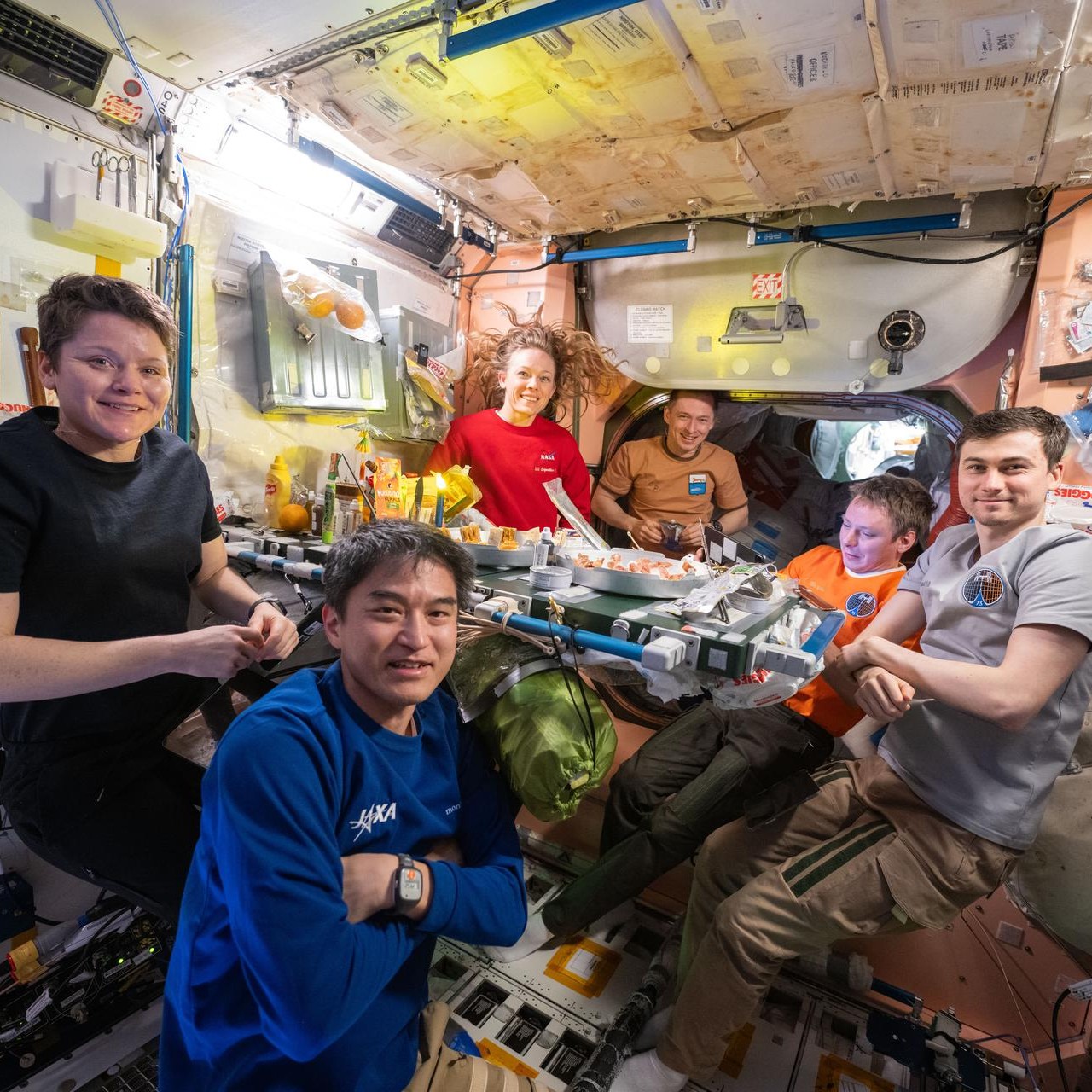
Expand ISS Expedition 73 crewmembers gather around the table for dinner in NASA’s Unity module.

The International Space Station (ISS) has two galleys – one in the Russian segment and the other in the NASA’s Unity module. Both are fitted with rehydration systems and food warmers. Although the ISS has a chiller to cool beverages, no fridge or freezer means the crews still rely heavily on “traditional” space food, although improved packaging and food processing provides a menu of about 200 different items. This can also include commercial off-the-shelf items to accommodate astronaut preferences. Crews can select from the NASA and Russian menus, so food containers are labelled in both English and Russian. 

Meals on the ISS are more conventional, as both galleys also have a “dinner table”, used for food preparation and communal meals. For special events and celebrations, the entire crew will gather around one table and eat together. 

Image credit: NASA

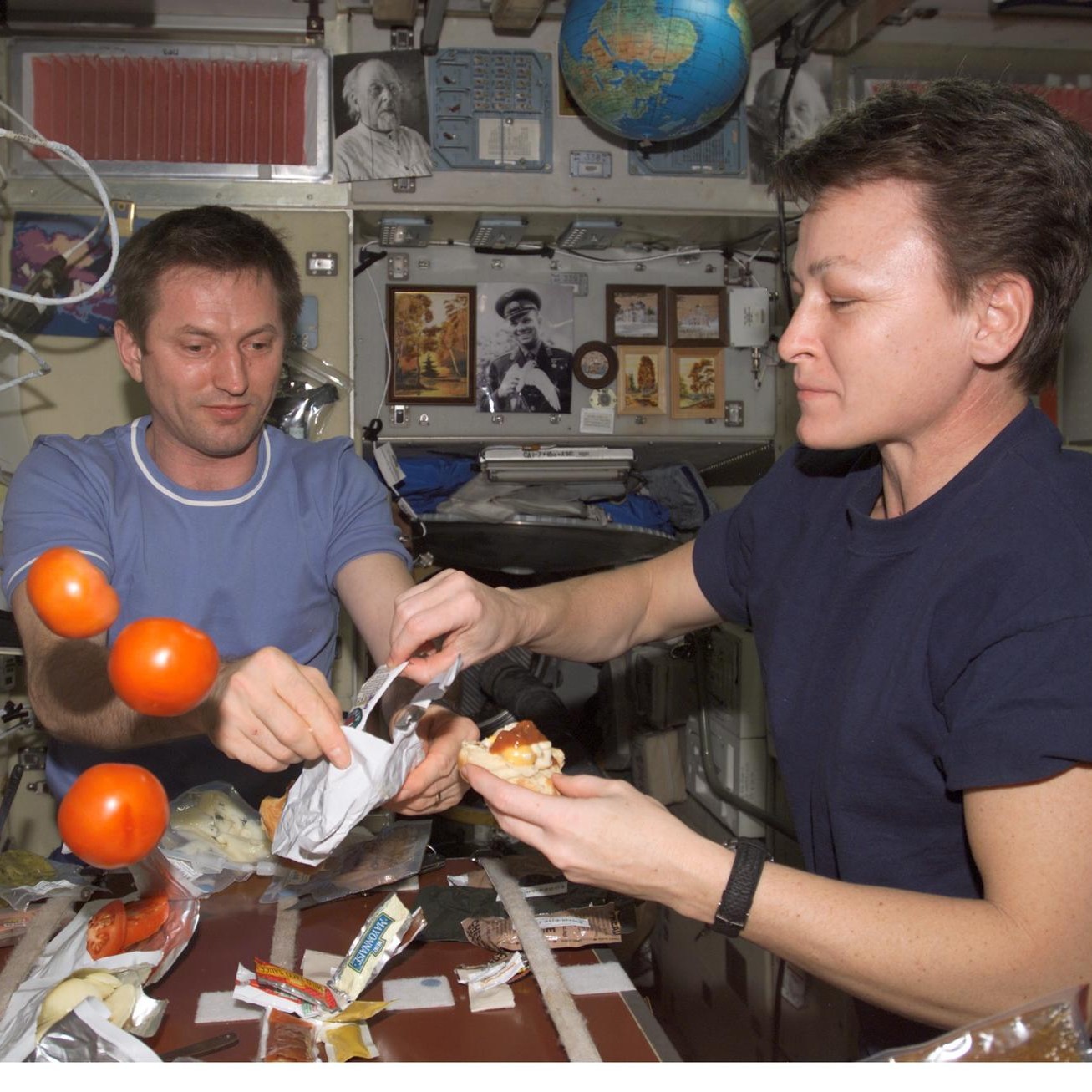
Expand Treschev and Whitson share a meal in the SM during Expedition Five on the ISS

Long-duration ISS crews crave fresh fruit and vegetables, so each spacecraft visiting the station carries supplies of fresh food: fruit, vegetables, fresh bread and other special treats like home-made soups and desserts. When they arrive, the crew make tasty meals like hamburgers, wraps – even pizza. (A Pizza Hut pizza was actually delivered to the ISS in 2001!). Experiments in growing food plants like lettuce and radish in microgravity, in preparation for lunar bases and Mars missions, also provide some fresh ingredients for meals. 

Visiting astronauts from ESA member countries, the Japanese Aerospace Exploration Agency (JAXA) and other countries often bring their own space food versions of national specialties, which are shared with their crewmates, providing additional menu variety. Hot sauces and other spicy condiments help to overcome the decrease in the sense of taste that occurs in microgravity. 

Image credit: NASA

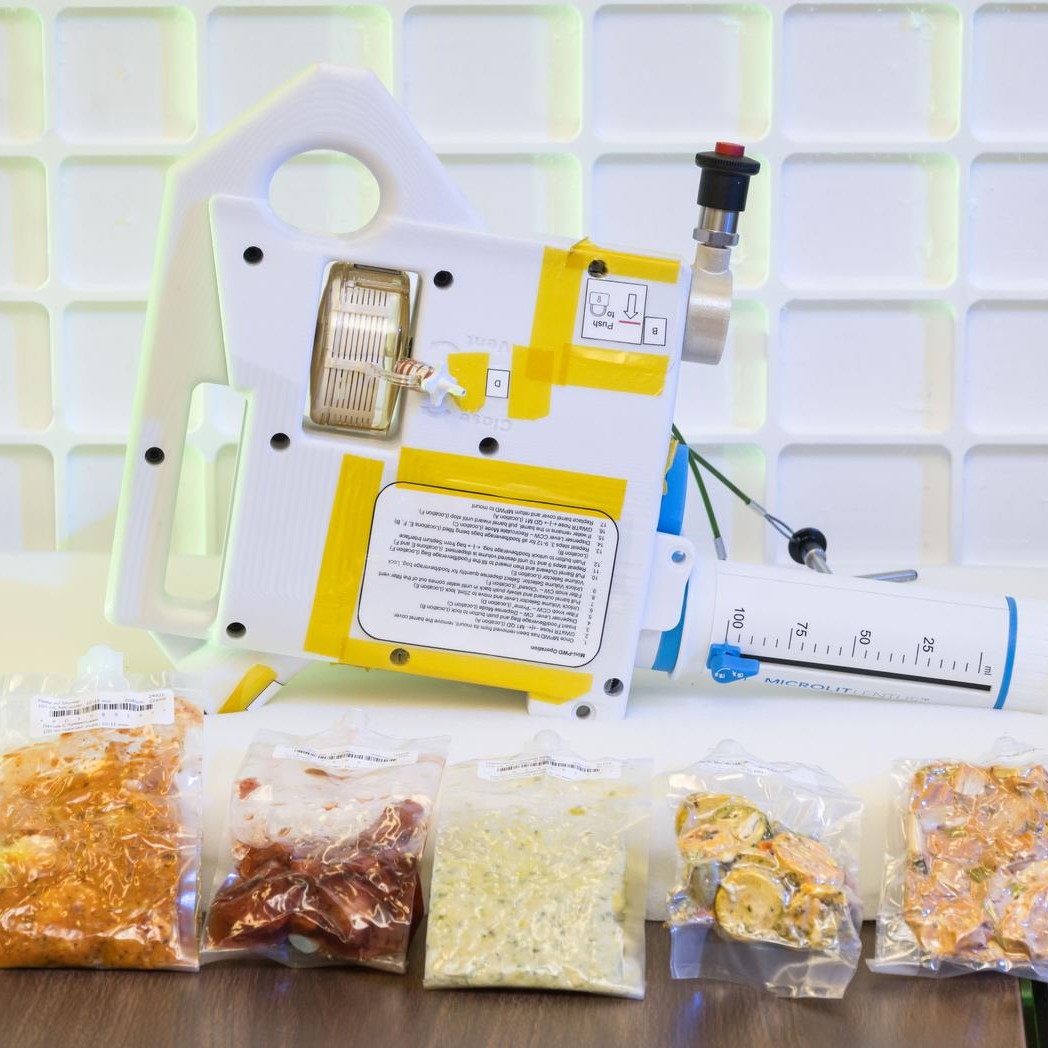
Expand A prototype of the Mini Potable Water Dispenser, currently in development at NASA’s Marshall Space Flight Center, is displayed alongside various food pouches during a demonstration at NASA’s Johnson Space Center.

On the way to the Moon space food is not just about survival, but also emotional support, helping the astronauts perform more effectively. The Artemis II menu provides a selection of 189 food and drink products for the 10-day journey. The Orion spacecraft carries a heater like the one used on the ISS to warm the crew’s meals.

The crew has the choice of more than 10 types of beverages, from coffee and green tea to lemonade and apple cider; five different hot sauces; cake and puddings; flavourings including peanut butter, spicy mustard, strawberry jam and honey; and a wide range of main courses, side dishes and snacks. With a Canadian astronaut aboard, five special Canadian food products including maple syrup and maple sugar cookies are also on the menu. It’s a lot more exciting than Gagarin’s tubes of meat paste and chocolate sauce, or the Apollo menu! 

Image credit: NASA

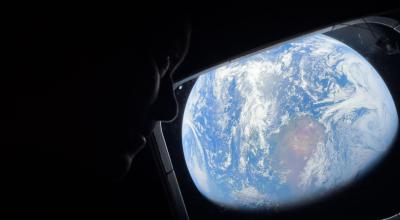
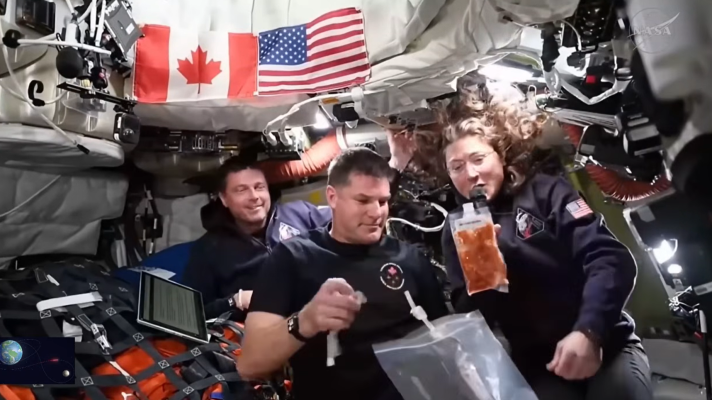
Main image caption: Inside the Orion capsule of Artemis II, Mission Specialist Jeremy Hansen showcasing a dehydrated container of freeze-dried green beans.

Image credit: NASA

Latest from the Australian space sector

Our department recognises the First Peoples of this Nation and their ongoing cultural and spiritual connections to the lands, waters, seas, skies, and communities.

We Acknowledge First Nations Peoples as the Traditional Custodians and Lore Keepers of the oldest living culture and pay respects to their Elders past and present. We extend that respect to all First Nations Peoples.

Back to top