
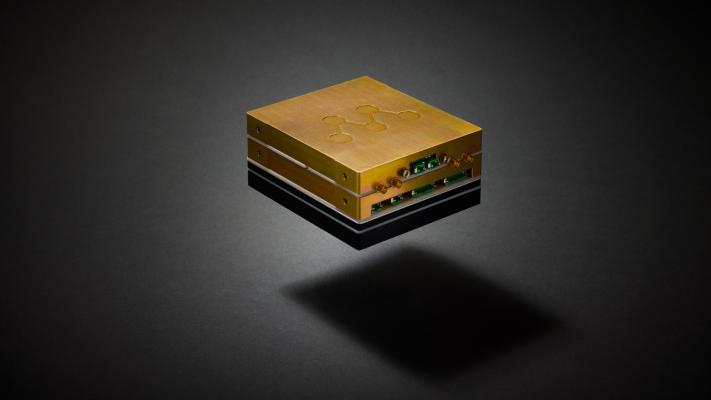
Myriota has announced completion of a new payload to support space missions with Internet of Things communication, using the space-enabled technology it currently provides on Earth.
The Adelaide-based company is world-renowned for delivering low-power, secure satellite IoT connectivity across the globe, including extremely remote and infrastructure-constrained environments.
The Next-Generation Communications Payload takes that same capability – enabling sensing, tracking, and monitoring of assets at global scale – and extends it into off-Earth applications.
The newly completed payload is designed for deployment in low lunar orbit, where it will provide resilient, flexible, and scalable communications for missions on and around the Moon.
Potential applications include astronaut health monitoring, lunar robotics, and inter-payload connectivity – supporting both government and commercial space operations.
Meanwhile, the advances in signal processing, system architecture, and payload design will directly enhance the performance, scalability, and efficiency of Myriota’s Earth-based IoT services.
The first-of-its-kind Australian-built solution was developed with support from the Australian Space Agency's Moon to Mars Demonstrator Mission program.
“For years, Myriota’s space-enabled IoT technology has been making a difference in critical sectors like agriculture, environmental management, and meteorology,” Mr Palermo said.
“This payload represents that same ingenuity taken to the next level, and exemplifies how Australia is ready to contribute to the future of exploration beyond Earth.”
~ Head of the Australian Space Agency Enrico Palermo

The design builds on technology Myriota provided for Kanyini – a South Australian satellite which just recently demonstrated NASA and IBM’s open-source Prithvi Geospatial AI foundation model.
Andrew Meldrum, Space & Mission Engineer at Myriota, said the new design introduces modular architecture, so the payload can be deployed across multiple satellite platforms and configured for increased computing capacity.
“We’ve moved from mission-specific designs to a flexible, modular architecture that can scale across platforms and missions,” Andrew said.
“As activity expands on and around the Moon – whether robotic or human – reliable, low-power communications become foundational infrastructure… this payload is designed to be part of that layer.”
The project also reflects a broader investment in Australian capability, with Myriota securing a $25 million investment from the Australian Government’s National Reconstruction Fund to scale local manufacturing and expand its global network infrastructure.
The project combined in-house development with Australian industry collaboration – including with ANSTO, Inovor Technologies, and the University of Adelaide.
Following a comprehensive test and qualification campaign, the new payload has now been approved by the Department of Industry and the Australian Space Agency for use in space.
Industry showcase
Australian space innovations making an impact.
Latest from the Australian space sector
Latest from the Australian space sector




Main image caption:The next-generation payload. Credit: Myriota