Why do astronauts wear blue?

When you picture an astronaut, what do you see? Perhaps it’s someone floating above Earth in a white spacesuit. Or maybe it’s the familiar sight of an astronaut in a blue flight suit, smiling for a photograph or meeting the public.

For many of us, that blue suit has become a symbol of the people behind space exploration. It’s worn by astronauts representing NASA, other agencies such as the European Space Agency (ESA), the Canadian Space Agency and, more recently, the Australian Space Agency. 

Soon, one very special blue suit will become part of Australia’s space story.

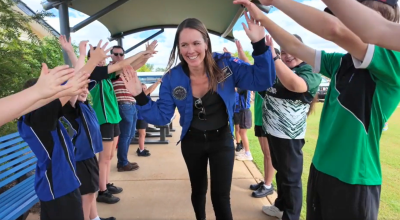
The flight suit worn by Aussie astronaut Katherine Bennell-Pegg during her training with ESA will go on display at Powerhouse Parramatta next month.

It marks her historic achievement as the first astronaut trained under the Australian flag and offers Australians a personal connection to that journey.

But why blue?

While the practice of astronauts wearing flight suits during their training goes back to the very beginnings of human spaceflight, they haven’t always been blue – or even the same shade of blue

NASA’s earliest astronauts wore their standard military flight suits when flying but were just as likely to wear their own civilian clothes during ground training and usually appeared in business suits for official appearances.

Wearing a blue flight suit during training appears during the Gemini program (1961-66), although it’s not completely clear why blue was the colour chosen: it may have been because many of the astronauts had backgrounds in the US Air Force, which uses the colour blue.

Apollo astronauts frequently wore blue cotton flight suits during their training and for some formal portraits. However, following the loss of the crew in the Apollo-1 pad fire in 1967, the Skylab and Apollo-Soyuz Test Project crews wore tan training coveralls and in-flight suits. This was the natural colour of the fire-retardant material from which they were made.

The blue flight suit we recognise today emerged in the late 1970s with the Space Shuttle program.

Made from fire-resistant Nomex, it gave astronauts a comfortable and durable uniform for training, aircraft operations, portraits and public appearances.

Even the shade has evolved, varying between lighter and darker blues across the Space Shuttle era to the royal blue commonly worn today to the International Space Station.

A powerful symbol of exploration

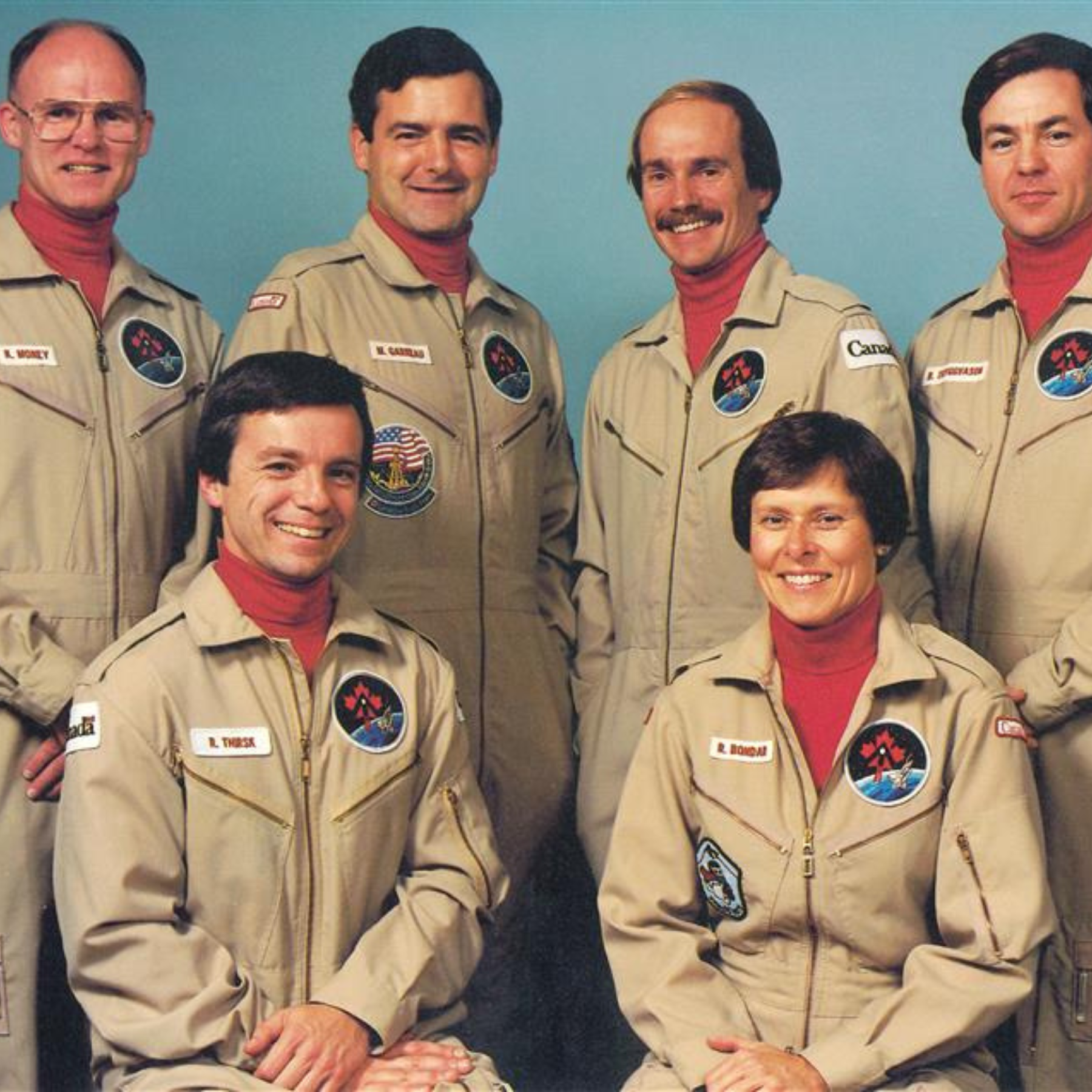
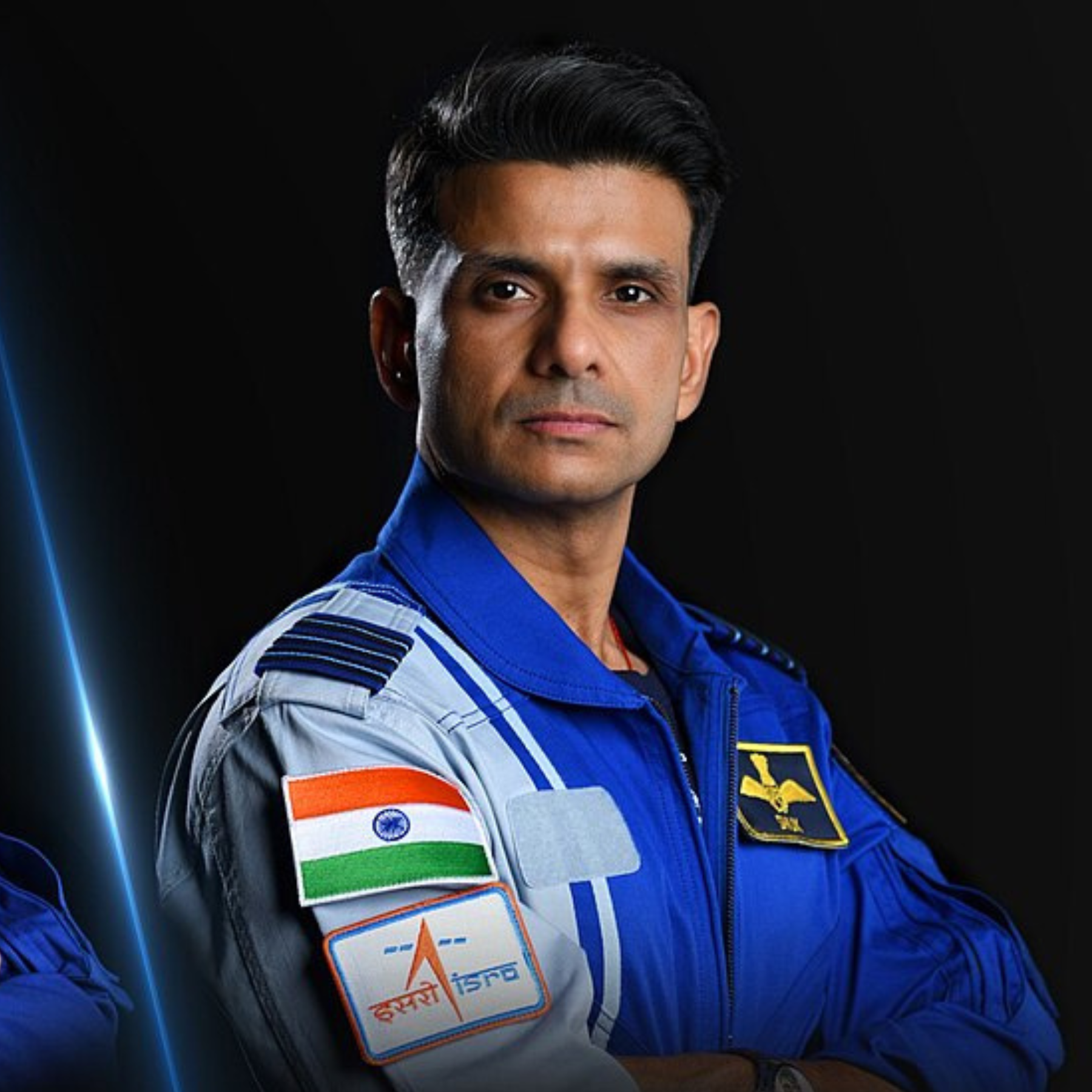
Other space agencies have also brought their own style to the flight suit. Canada’s first astronauts wore fawn suits before adopting NASA blue, which is also worn by ESA and Japanese astronauts. India’s Gaganyaan astronauts, meanwhile, wear a distinctive blue-and-white design.

From practical workwear to a powerful symbol of exploration, the blue flight suit has become part of the astronaut identity. 

Photo essay

Explore our interactive photo gallery to learn about the history of astronaut flight suits and the many shades of blue that can be traced back to the 1960s.
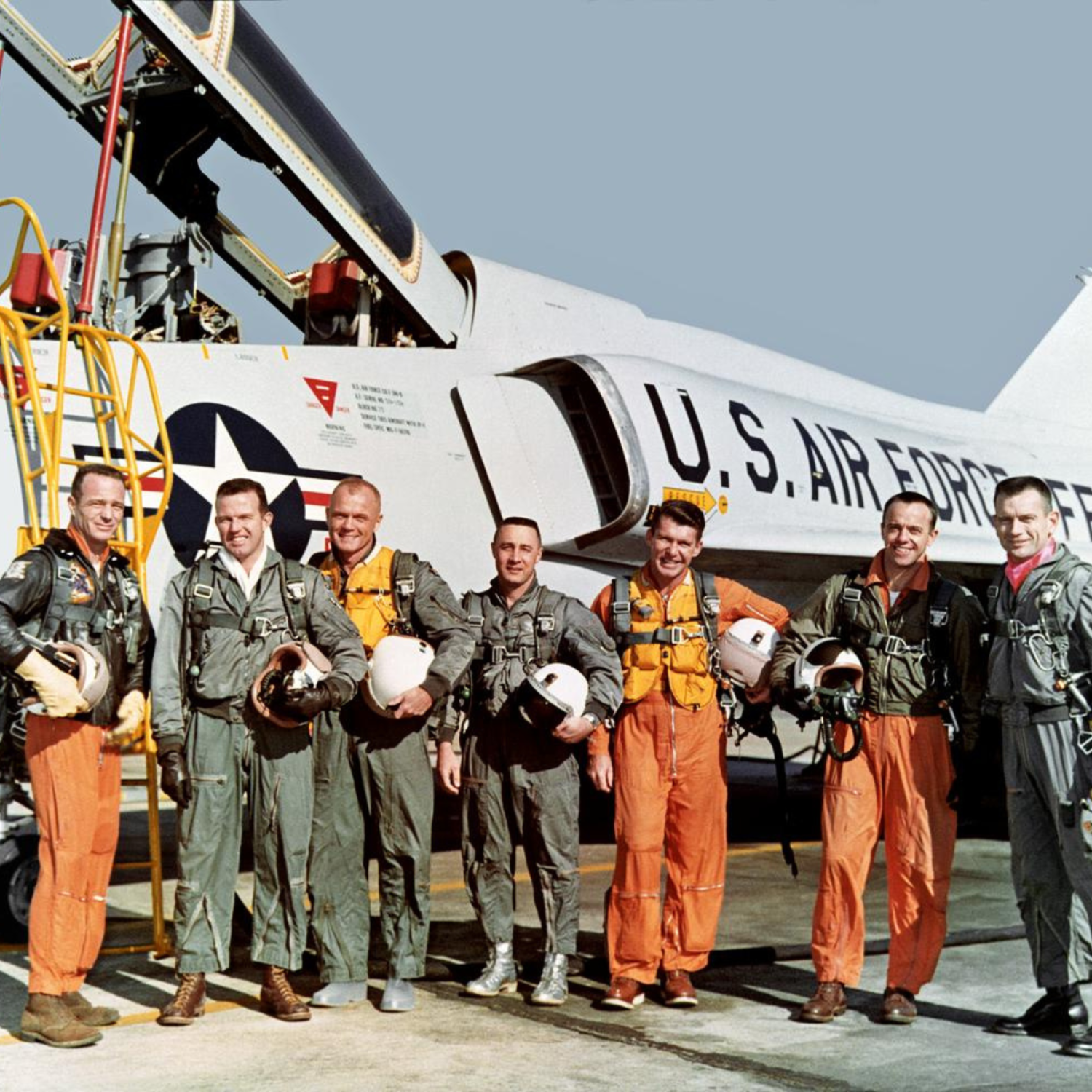
Expand NASA’s original Mercury program astronauts. Credit: NASA

NASA’s original Mercury program astronauts were military pilots on detachment to the space agency and wore their service flight suits when flying during their training. 

The three astronauts in orange flight suits (left to right: Scott Carpenter, Wally Schirra and Alan Shepard) were naval aviators. 

US Navy pilots wore the bright orange garments so they could be easily seen by rescue services if they were forced to ditch at sea. 

During the Mercury program, astronauts usually wore civilian clothes for training and public appearances, with the blue flight suit appearing by the mid-60s, during the Gemini program.

Credit: NASA

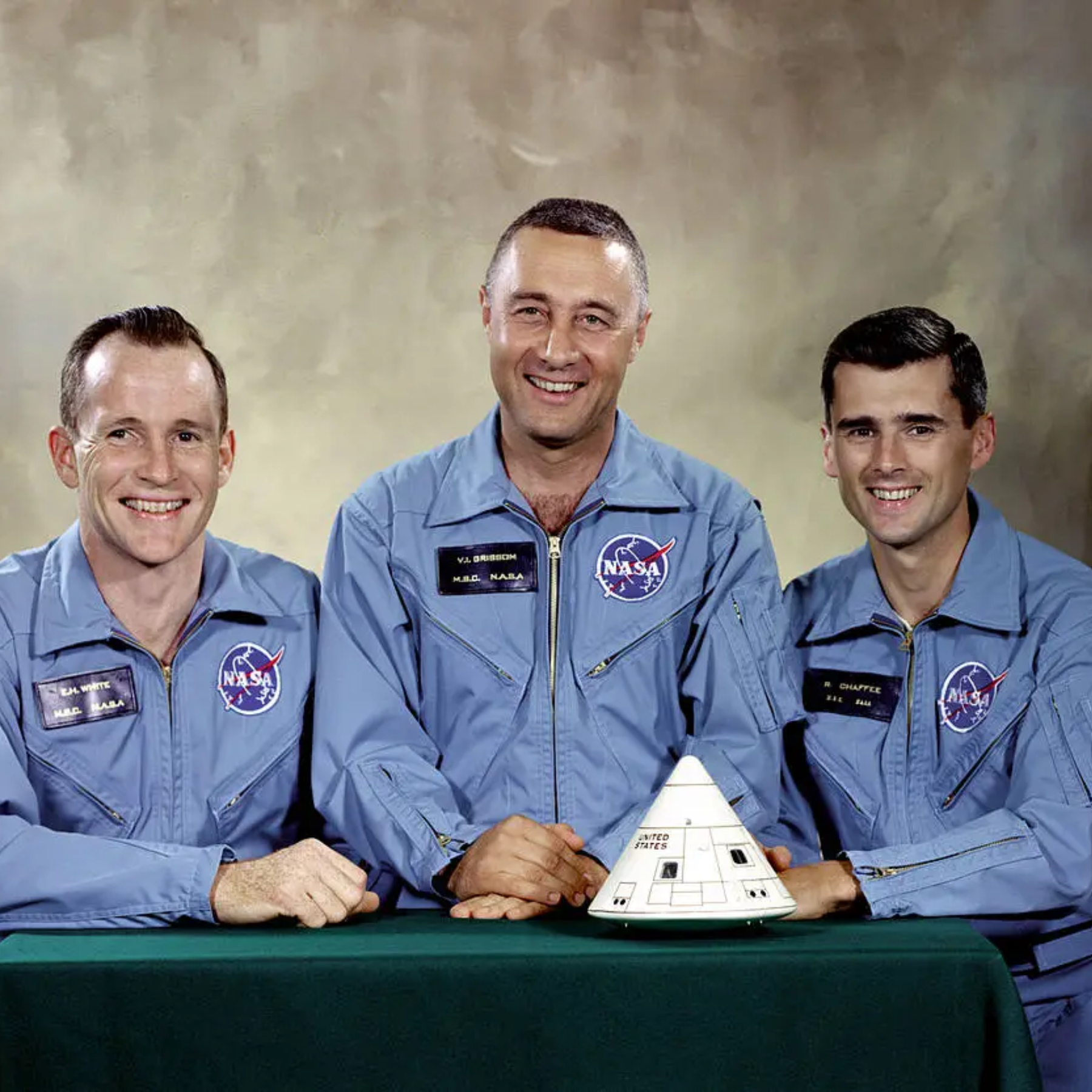
Expand The crew of the Apollo-1 mission posed for their official mission portrait in their heavy cotton blue flight suits Credit NASA

The crew of the Apollo-1 mission posed for their official mission portrait in their heavy cotton blue flight suits (left to right: Edward White, "Gus" Grissom, and Roger Chaffee). 

They were tragically lost in January 1967 in a fire in their spacecraft on the launchpad during a pre-launch simulation. 

This accident led NASA to look for fire-retardant materials for future astronaut flight suits and in-flight garments. Introduced during the Apollo program, in-flight garments were designed as a lightweight, fire-resistant “casual wear” that was more comfortable than a spacesuit inside the spacecraft's shirtsleeve environment. 

Apollo in-flight suits were made of betacloth. 

Credit: NASA

Expand Crews for NASA’s Skylab space station program credit NASA

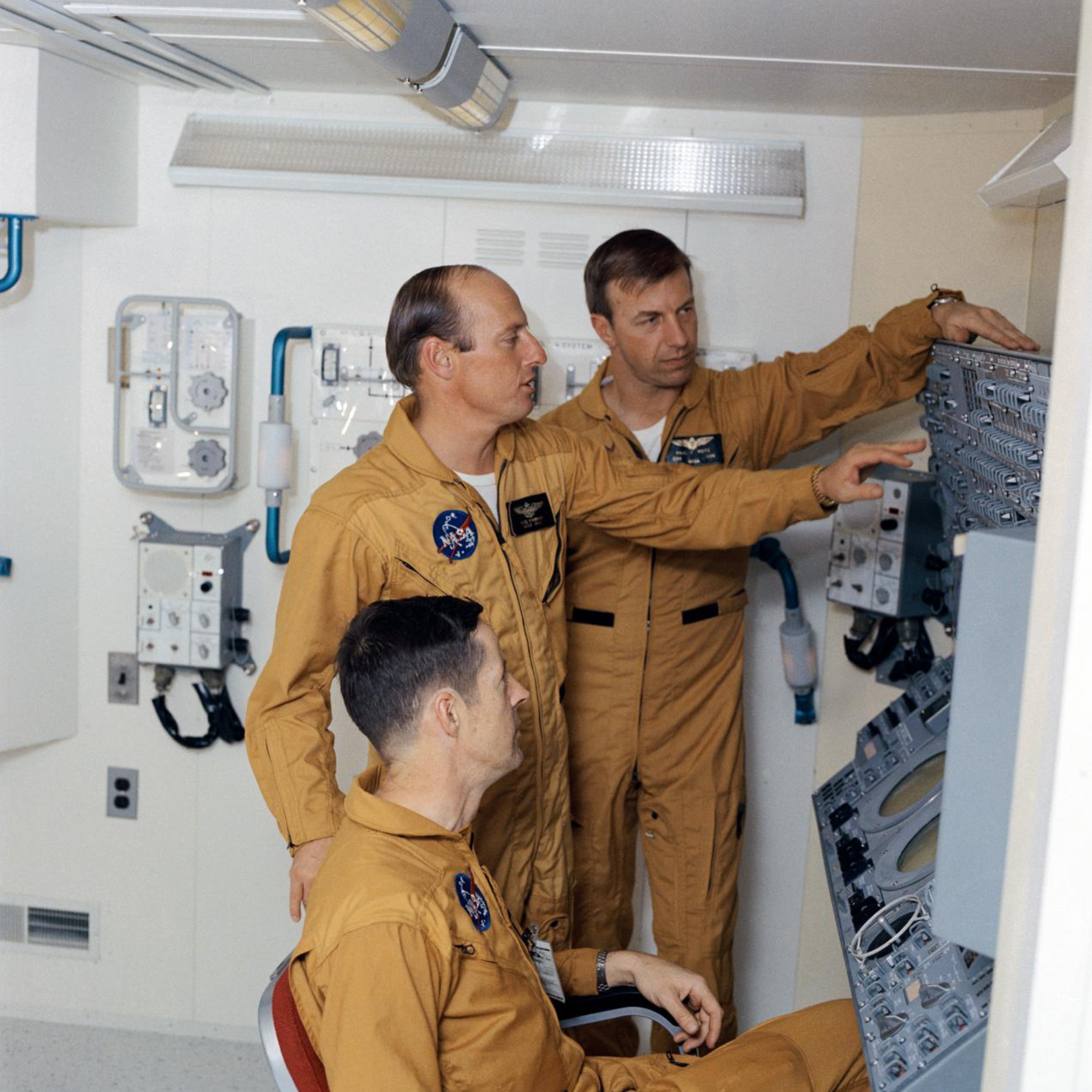
Crews for NASA’s Skylab space station program (1973-74) and the Apollo-Soyuz Test Project (ASTP, 1975), wore tan flight suits. 

This colour was the natural hue of the fire-resistant material from which they were made, polybenzemidazole (which the astronauts called PBI). PBI was used for pilot flight suits because its superior thermal performance provided more burn protection than similar materials. 

More comfortable than Apollo’s itchy betacloth, NASA adopted PBI for the Skylab/ASTP training flight suits and on-orbit wear. Wearing their PBI garments during training are the crew of Skylab-2(left to right: “Pete” Conrad, commander, standing; scientist-astronaut Joe Kerwin, seated; Paul Weitz, pilot). 

Credit: NASA

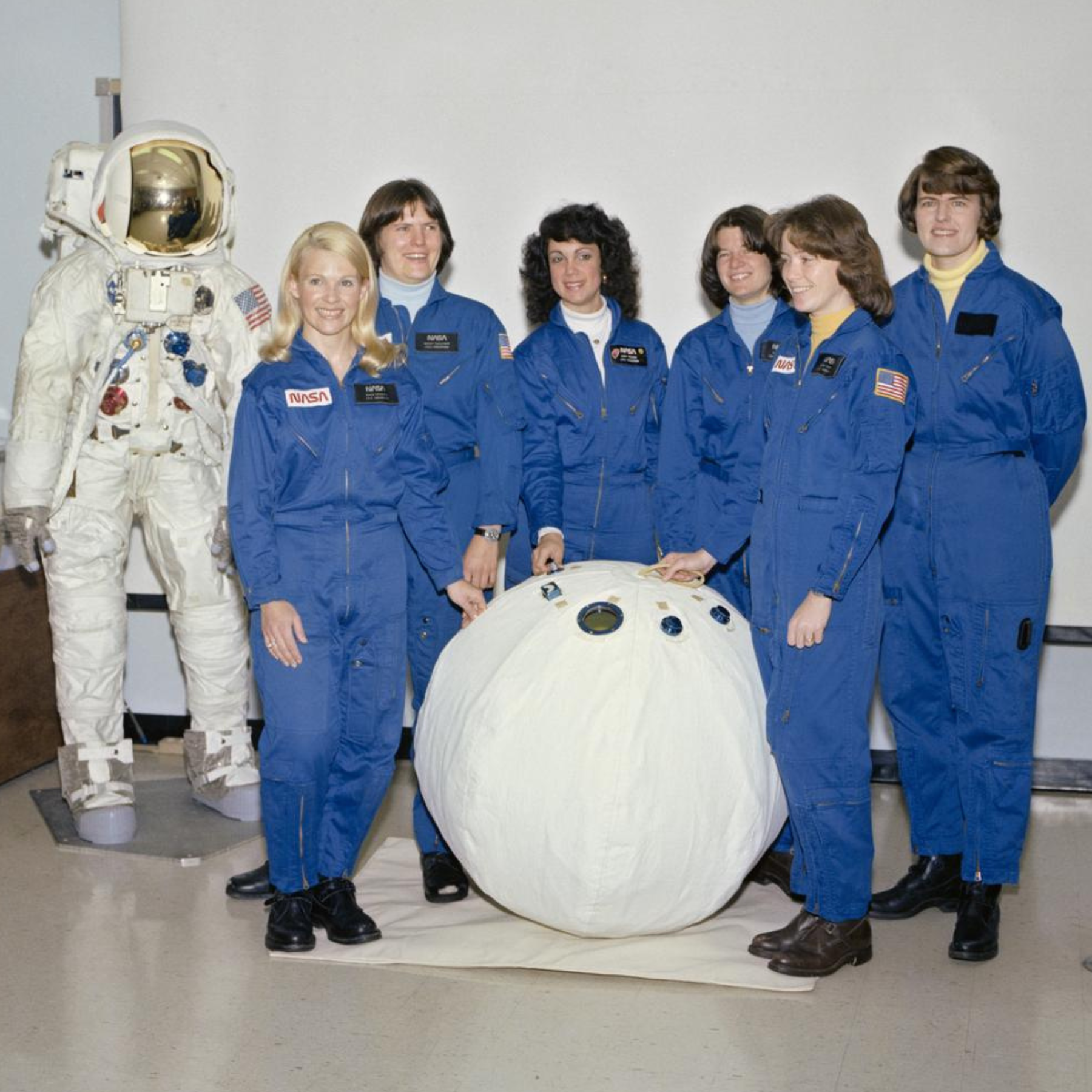
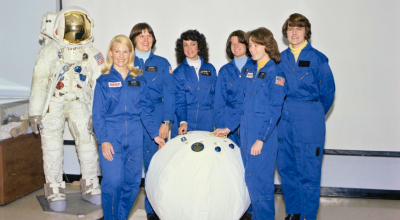
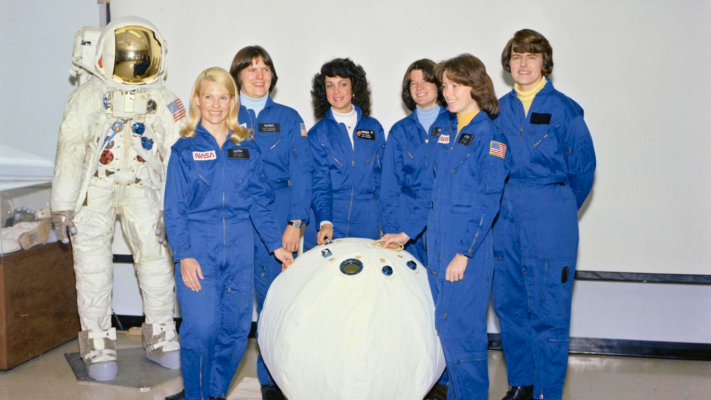
Expand The “Astronaut Class of 1978” (Group 8), included the first female astronauts, seen here posing with a “Personal Rescue Enclosure Credit: NASA

Improvements in textile technology enabled fire-retardant materials to be coloured blue without significant degradation of their protective qualities. 

This allowed NASA to introduce the “classic” Nomex blue flight suit that we usually think of today as astronaut wear for the Space Shuttle program. The “Astronaut Class of 1978” (Group 8), included the first female astronauts, seen here posing with a “Personal Rescue Enclosure.”

Left to right: Rhea Seddon, Kathryn Sullivan, Judy Resnik, Sally Ride, Anna Fisher and Shannon Lucid), designed to rescue an astronaut without a spacesuit. 

The shade of blue used for Nomex flight suits has varied over time. 

Credit: NASA

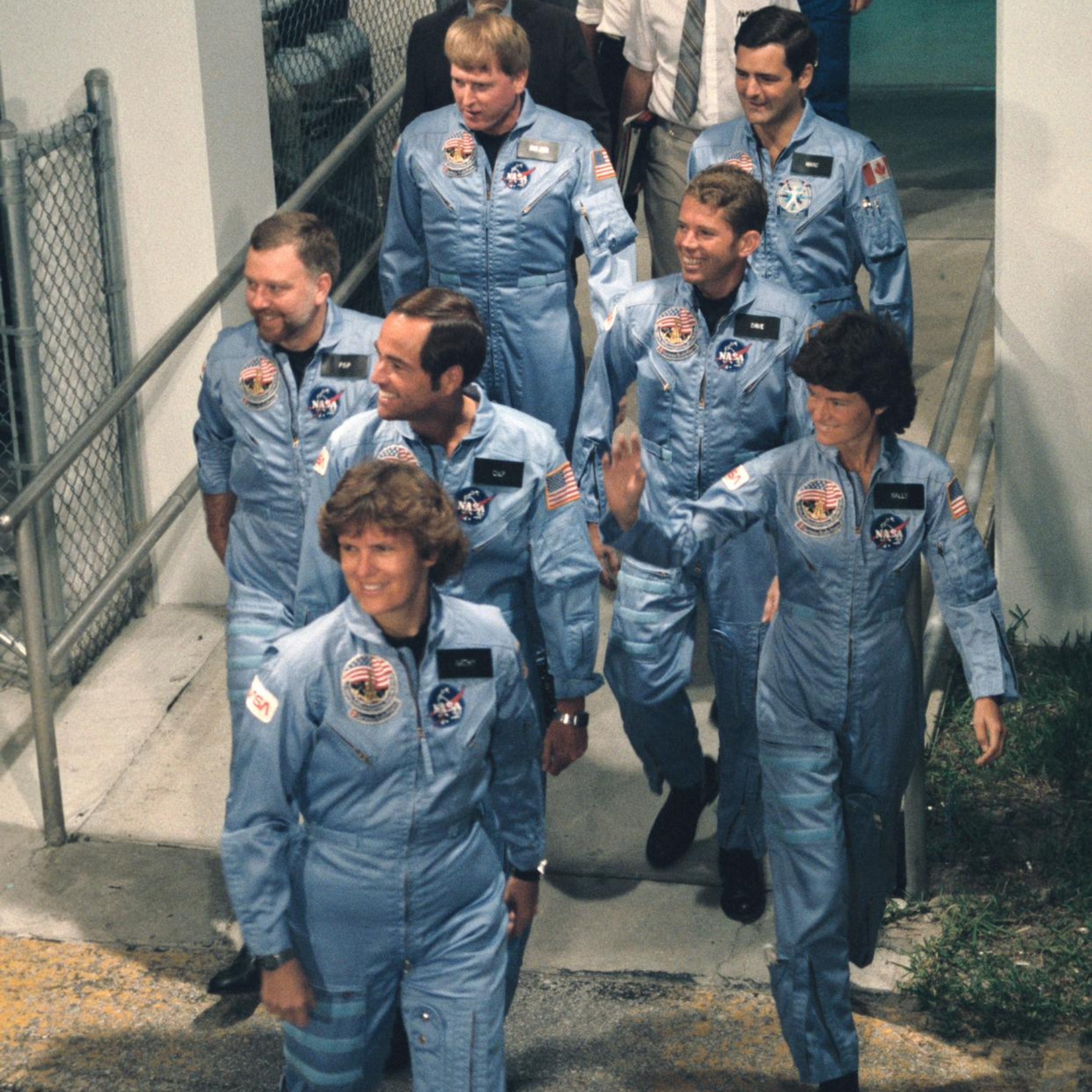
Expand The crew for 1984’s shuttle mission Credit NASA

Early Space Shuttle flight suits were often a light blue shade and, prior to the loss of the Shuttle Challenger, were worn for launch as well as in-flight. 

The crew for 1984’s mission STS-41G is seen here on their way to the launchpad. 

Leading the way is Kathryn Sullivan followed in file by Bob Crippen, Paul Scully-Power (the first Australian-born person in space, an oceanographer flying as a US citizen) and Jon McBride. 

On the right side are Sally Ride, David Leestma and Marc Garneau (the first Canadian Space Agency astronaut in space). 

Credit: NASA

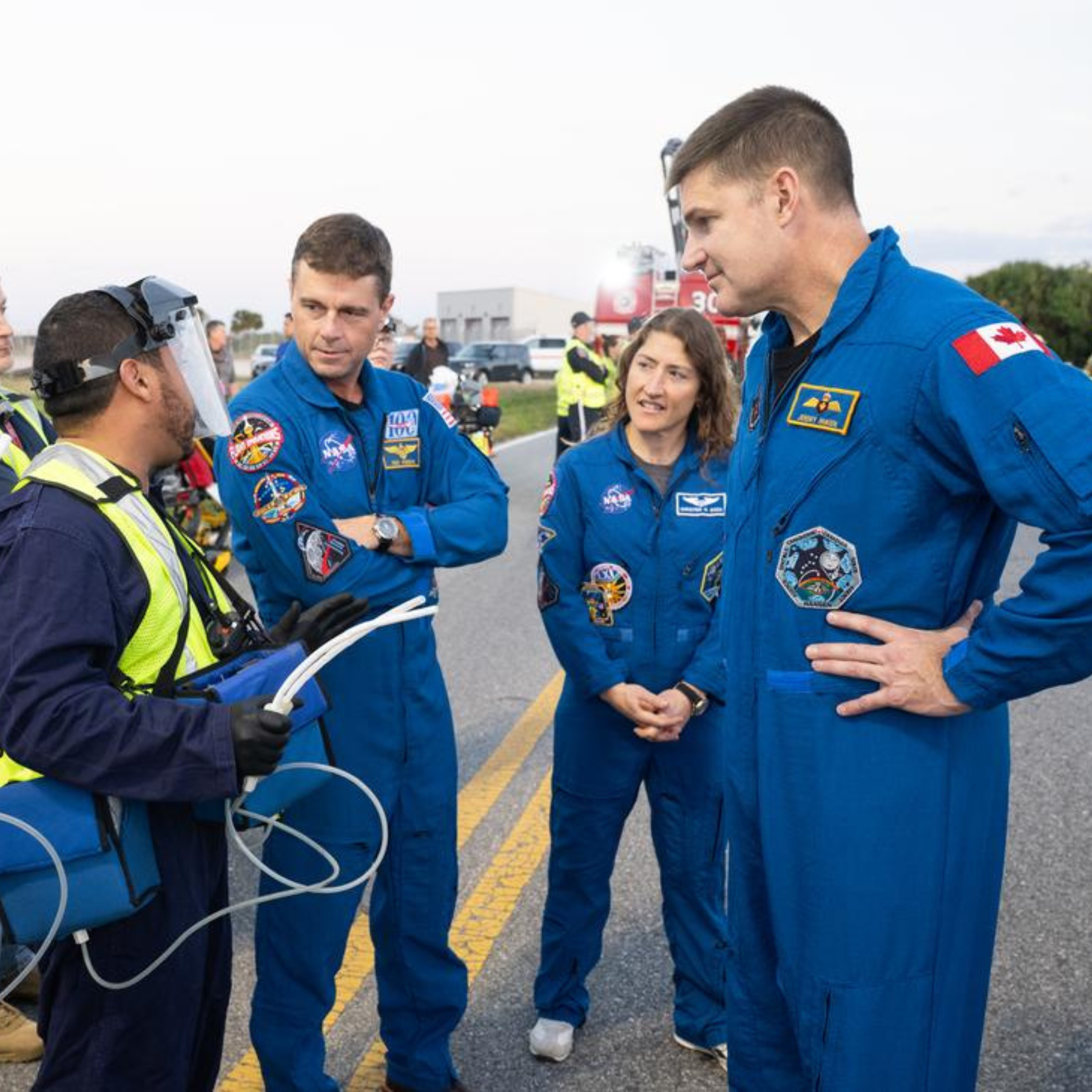
Expand NASA’s current blue flight suit, worn by members of the Artemis II crew during training in 2025 Credit: NASA/Joel Kowsky

NASA’s current blue flight suit, worn by members of the Artemis II crew during training in 2025. 

Left to right: Reid Wiseman, commander; Christina Koch, mission specialist; and Canadian Space Agency astronaut Jeremy Hansen, mission specialist. 

The crew were practicing various emergency rescue and triage training scenarios at NASA's Kennedy Space Centre in Florida.  

The bright orange gear the Artemis II crew wore at launch was the Orion Crew Survival System Suit (OCSSS), a pressure suit which is not designed for space- or Moonwalking, but for the critical moments of launch, entry, and emergencies in deep space.

Credit: NASA/Joel Kowsky

Expand Canada’s first group of astronauts Credit: Canadian Space Agency

Canada’s first group of astronauts, recruited from more than 4,000 applicants, originally wore distinctive fawn flight suits. 

Selected based on their exceptional academic backgrounds, professional experience, health, and communication skills, they flew with NASA in the Space Shuttle program: 

Back row (left to right) Ken Money, Marc Garneau, Steve MacLean and Bjarni Tryggvason; Robert Thirsk and Roberta Bondar, seated. 

Today, Canadian astronauts train and fly wearing blue NASA flight suits, proudly bearing the Canadian flag on their shoulder.

Credit: Canadian Space Agency

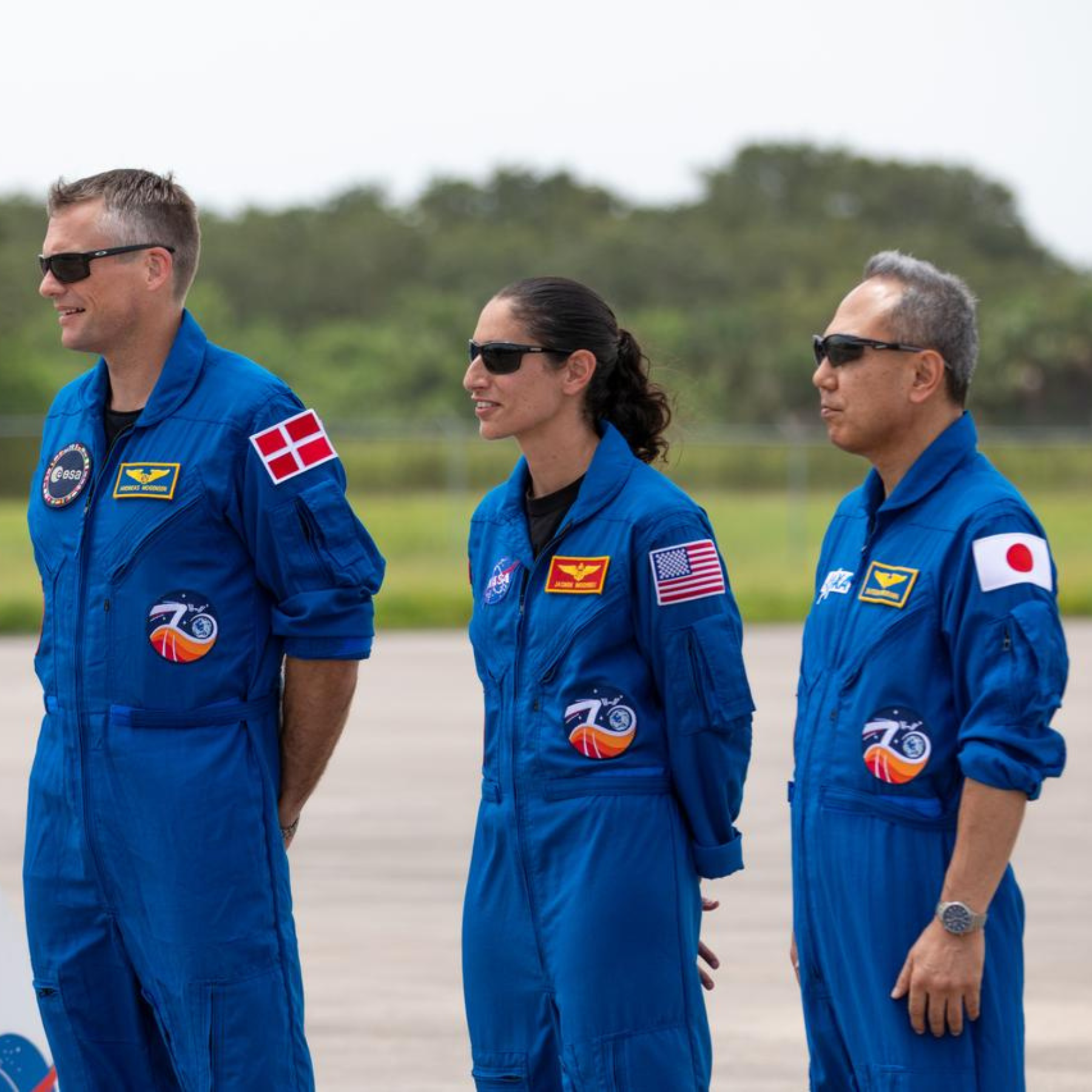
Expand crew of NASA’s SpaceX Crew-7 mission to the International Space Station Credit: NASA

Astronauts from four different space agencies made up the crew of NASA’s SpaceX Crew-7 mission to the International Space Station, in 2023, each blue flight suit bearing the patches of their respective agencies and the flags of their countries. 

From left are ESA astronaut Andreas Mogensen from Denmark, NASA astronaut Jasmin Moghbeli, and JAXA (Japan Aerospace Exploration Agency) astronaut Satoshi Furukawa. 

The International Space Station has provided a permanent human presence in space since 2000, operated by five space agencies, representing thirty-one countries – an outstanding example of international co-operation in space. 

 Credit: NASA

Expand gaganyatri with the Indian Space Research Organisation Captain Shubhanshu Shukla Credit: Indian Space Research Organisation

The Gaganyaan astronauts of the Indian Space Research Organisation (ISRO) wear distinctive blue-and-white flight suits that were designed by India’s National Institute of Fashion Technology (NIFT) in Bengaluru, in consultation with ISRO and the astronauts themselves. 

The colour scheme was designed for visual impact, selected after fashion students and the NIFT design team produced about 70 colour and design variations for evaluation. 

The flight suits are intended to be an inspiring and highly visible symbol of India's entry into the small group of nations with an independent capability for human spaceflight. 

In this photograph is ISRO gaganyatri Captain Shubhanshu Shukla 

Credit: Indian Space Research Organisation 

Latest from the Australian space sector

Our department recognises the First Peoples of this Nation and their ongoing cultural and spiritual connections to the lands, waters, seas, skies, and communities.

We Acknowledge First Nations Peoples as the Traditional Custodians and Lore Keepers of the oldest living culture and pay respects to their Elders past and present. We extend that respect to all First Nations Peoples.

Back to top