While Australia’s east coast has been helping the Artemis era of lunar exploration, the west is powering up a new chapter in deep space science for Europe.
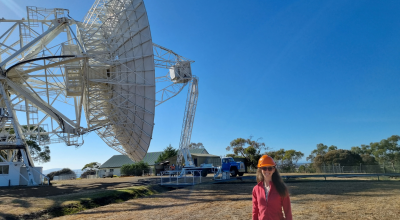
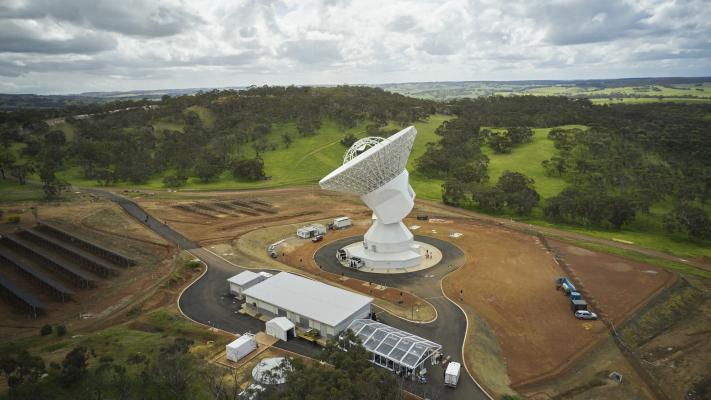
From 1 April, the European Space Agency's (ESA) newest deep space antenna – New Norcia 3 (NNO‑3) – entered nominal operations, marking a fresh milestone in Australia’s 40‑year partnership with Europe in space.
Co‑funded by the Australian Space Agency, NNO‑3 is the latest edition of ESA’s Estrack ground station network, strengthening Europe’s ability to communicate with scientific, exploration and space‑safety missions across the Solar System.
This outback antenna was inaugurated in October last year by ESA's Director General Josef Aschbacher and Head of the Australian Space Agency Enrico Palermo.
From Perth to the planets
Located 140 kilometres north of Perth, the New Norcia ground station, operated by CSIRO, offers something mission controllers prize: Geography.
Its position helps provide around‑the‑clock coverage as spacecraft move across the sky and Earth rotates – filling critical communications gaps and improving the reliability of tracking, commanding and downlinking valuable data.
Showcasing why Australia's stable operating environment, strong technical capability, and unique location in the southern hemisphere make it an ideal base for international space partnerships and explorations.
NNO‑3 also supports international partners in the United States, Japan and India, as well as commercial missions – boosting science returns and operational efficiency.
A smarter antenna for fainter signals
ESA's Euclid mission has been in deep space since 2023 exploring how the Universe has expanded. This mission – that will travel 1.5 million kilometres away from Earth – became the first spacecraft to be tracked by NNO-3.
The new deep space antenna in our western outback, NNO-3, brings major technical features, including:
- It can downlink in X‑, K‑ and Ka‑band and uplink in X‑band, with K‑band uplink planned for the future.
- It also uses cryogenically cooled receivers operating at −263°C, reducing background “noise” and making it easier to detect signals that can be weaker than a whisper from billions of kilometres away.
- The system also includes a high‑power radio transmitter helping ensure commands remain detectable even across enormous distances where radio waves naturally weaken.
Building the next phase of Australia-Europe cooperation
Australia and ESA already collaborate across deep space communications, navigation, data analysis, mission support and, more recently, human spaceflight.
Last year, Australia announced a mandate to begin negotiations on a Cooperative Agreement with ESA – a practical pathway to help Australian businesses and researchers access ESA programs and missions, while enabling more European activity in Australia.
With European flagship missions supported from New Norcia – such as JUICE, Solar Orbiter, BepiColombo, Mars Express, Euclid, Hera and more – this antenna is more than a dish in the desert.
It’s a statement: Australia is helping shape the next era of space exploration, from the ground up.
Preparations are already underway for ESA’s next 35 metres deep space antenna at New Norcia with ESA member states approving the funding for the project at their November 2025 Ministerial Council.

International partnerships
We are the gateway for the global space industry to engage with Australia in space.
Main image caption: ESA's New Norcia ground station in Western Australia.
Credit: ESA/Fisheye