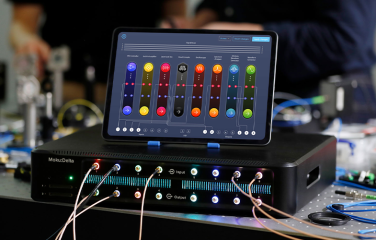
Government-backs Australian innovation that can connect missions from Earth to the Moon and beyond.
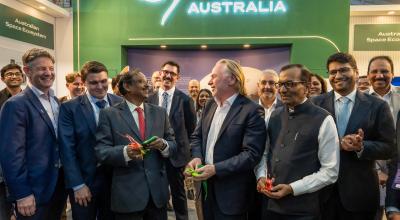
Canberra-based technology company Liquid Instruments has secured $70 million in Series C funding to accelerate the commercialisation of its software-defined instrumentation platform, with the round co-led by Australian Government established National Reconstruction Fund Corporation (NRFC) and US-based Keysight Technologies.
The NRFC has invested $28.45 million to support Liquid Instruments to consolidate and scale its manufacturing operations in Australia. The investment will help keep high-value engineering and advanced manufacturing capability onshore, while supporting the creation of new highly skilled product engineering roles.
“NRFC funding will keep Liquid Instruments in Australia, and our cornerstone investment will crowd-in significant private capital from overseas while creating highly skilled jobs in Australia,” said NRFC CIO Dr. Mary Manning.
Today's investment announcement builds on Australia’s growing sovereign space capability.

Backing local capabilities and giant space leaps
During Artemis II, ANU’s ground station in Canberra was positioned to help track, transmit, and receive optical communications from NASA’s Orion spacecraft – showcasing Australia’s ability to support future lunar explorations from the Southern Hemisphere.
Australia’s role in Artemis II demonstrates how Government investment in local space capability can support landmark international missions.
In 2023, through the Australian Space Agency’s Moon to Mars Initiative, an ANU-led consortium with Liquid Instruments, Platypus R&D and SSC Australia received $4.5 million to upgrade the University's Quantum Optical Ground Station.
In this Australian Government-backed industry consortium, Liquid Instruments contributed to advancing Aussie‑manufactured electronics and instrumentation capability.
Three years on, in April 2026, this investment proved to be pivotal as it helped beam 4K video back to Earth from NASA's historic Artemis II mission that took humans the furthest from Earth than ever before.
Liquid Instruments is part of another Australian Government-backed project that will use Artificial Intelligence to monitor the health of astronauts, patients and remote workers.
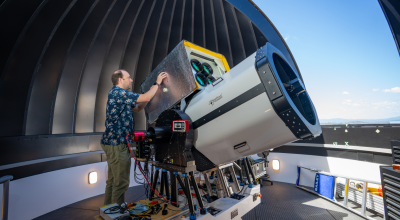
Industry showcase
Australian space innovations making an impact.
Main image: Technology from Liquid Instruments.
Credit: NRFC