
An Outback lesson for the Moon
Before Daniel Bloomfield helped solve a problem for the Moon, he had to cross the iconic Simpson Desert.
The 47-year-old engineer and full-time carer still remembers riding through one of Australia's most unforgiving landscapes: 500 kilometres of isolation, hundreds of sand dunes and the constant knowledge that a mechanical failure could leave him stranded far from help.
Years later, when NASA challenged engineers around the world to design a wheel capable of surviving the lunar surface, Daniel's thoughts did not turn to research papers or existing space technology.
Instead, they returned to the Australian outback in the centre of the continent.
The lesson he took from the desert was simple: in the harshest environments, the best designs are not necessarily the most complex. They are the ones that keep working when something goes wrong.
That lesson would ultimately carry Daniel from a regional Victorian driveway to the winner's circle of a prestigious NASA engineering competition that invited next-generation lunar rover wheels.
In July, after competing against 128 submissions and 49 countries, Daniel was one of the five finalists for the Rock and Roll with NASA Challenge, where he went wheel-to-wheel against some of the most novel solutions at NASA’s Johnson Space Center in Houston, US.

Daniel inspecting his motorbike during his trip across the Simpson Desert in 2014.
“When I thought about the Moon, the closest thing I could relate it to was the Simpson Desert.”
Aussie ingenuity can emerge from the most unexpected places
Rather than immersing himself in existing lunar wheel technologies, Daniel deliberately avoided researching them too closely.
He believed every moving component introduced another opportunity for failure.
“I just kept eliminating things,” he said. “Springs could break. Pivots could jam. What was left was something spongy.”

An early prototype of Daniel's wheel.

An early prototype of Daniel's wheel.
His solution became known as the "Scotch Pad Tyre", named after the familiar kitchen scourer, because it helped people instantly visualise the concept.
Behind the simple name sat a flexible fibrous wheel designed to deform around rocks and uneven ground while retaining its shape.
Daniel spent months refining the idea in his head. Then he realised the competition deadline was that very day.
An overnight design sprint followed, with drawings, material plans and a CAD model completed by 5am.
NASA selected the concept for the next stage and awarded him funding to build a prototype.
“I thought if I was going to submit something, it needed to keep working even when it breaks.”
Building against the clock: Family, setbacks and a NASA deadline

Along with his wife, five sons, and multiple horses, Daniel lives 50 kilometres from Melbourne's central business district – in a town in regional Victoria that recorded a population of 981 at the 2021 census.
His driveway quickly became an engineering workshop.
Using skills developed over decades, first as a mechanical engineer and later as a maker for the town while caring for one of his five sons, he tested materials, fibres and binding methods. Some showed promise. Others failed completely.
Each setback provided another lesson.
His eldest Isaac (20), now an apprentice electrician, became a sounding board, regularly discussing new ideas and prototypes after work.
Then, as the deadline approached, life delivered a far greater challenge.
Daniel's son Dustynn was admitted to intensive care at Shepparton Hospital, about 200 kilometres from home.
For two weeks, Daniel spent his days at the hospital and his nights building the wheel.
"It was hectic," he recalled.
Once the prototype was finished, NASA required video evidence showing it could travel across sand, gravel and rocks.
Daniel approached a local gravel supplier and explained that he needed materials for a NASA project.
The response was typically Australian. Staff filled his buckets and refused payment.
“Just give us a shout-out when you succeed,” they told him.

From a regional driveway to a NASA-winning Moon wheel
The finished wheel weighed 2.63 kilograms and could travel to a top speed of 24 kilometre per hours. It used Kevlar fibres and a flexible structure designed to contour around uneven terrain.
A treated outer surface incorporating epoxy and corundum grit provided additional traction. By creating greater surface contact, the wheel generated more grip while avoiding many of the weaknesses associated with rigid systems.
It was simple.
It was practical.
And it was built to endure.
NASA named Daniel's concept the winning design and later expressed interest in obtaining additional wheels to further explore the technology.

But the significance of the story goes beyond a prize
Daniel's winning idea was inspired by a journey across the Simpson Desert and developed between caring responsibilities, hospital visits and late nights in a regional workshop.
His achievement highlights a growing reality for Australia's space sector.
Innovation does not only emerge from major research institutions or corporate laboratories.
It can come from sheds, paddocks, and determined individuals willing to tackle problems differently.
"The wheel may have been designed for the Moon, but its origins are unmistakably Australian," reflects Daniel.
And that may be precisely why it succeeded.

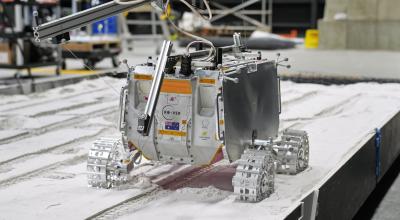
Meet Roo-ver
The Australian-made rover that will go to the Moon with NASA.